
When I can’t attend a conference (and that is most of the time) I like to learn vicariously  through other attendees. I follow hashtags on Twitter, I look at posts of Facebook or Instagram, and I read the blogs of those who share out. I think it is only fair to reciprocate whenever I can. Last week I attended NCTE18 in Houston and tried to tweet out quotes and highlights as well as my sketchnotes. (You can see all of my #NCTE18 sketchnotes HERE)
So what did I take away from this conference (other than dozens of books for my TBR stacks?) Here are some of my Ah-ha’s and Oh-yeah’s in sketchnote form…
Raising Student Voice: What is our Role in Equity and Justice in the Classroom?

Cornelius Minor gave me lots of food for thought:
Oppression can be pervasive in seemingly innocuous practices that our privilege blinds us to. Open our minds and eyes to how others may feel left out or less-than with the systems we consider ‘normal’.
There is a big difference between DIVERSITY (“all the people are at my table“) and INCLUSIVITY (“I change the rules for all”). Where do my beliefs and actions fall?
Sharpening the Intervention Lens Through Responsive Conversations
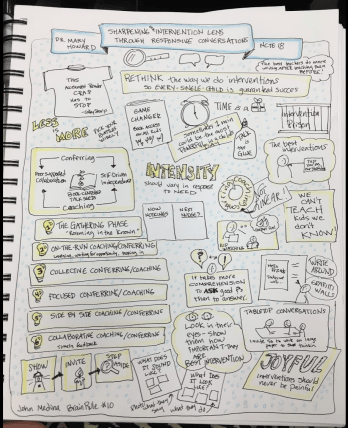
Dr. Mary Howard always provides me with ample Ah-ha moments and she didn’t disappoint this time.
She challenges us to rethink interventions-that sometimes 1 minute could be the most powerful in a child’s day if we are responsive to their needs.
The best teachers do more writing after teaching than before.
Interventions should be JOYFUL, not PAINFUL.
We can’t TEACH kids we don’t know! Look in their eyes and show them how important they are!
Enacting Sustainable Teaching: How Mindfulness, Embodiment, and Literacy Practices Can Help You Stay in the Profession for the Long Haul

Teaching is one of the few professions that intersects professional and private lives. We need to embrace Sustainable Teaching Practices. The presenters from CSU Writing Project shared some of their research and understanding.
I will definitely be revisiting these ideas in future posts. You can check out their website at https://www.csuwritingproject.net/what-is-sustainable-teaching.html
If we don’t find a sustainable balance between our professional and personal lives, we are destined for burnout and stress-and that doesn’t allow us to be the best teachers, parents, spouses, friends, or family-members we can be.
Keepin’ it Real: Authentic Responses to Reading
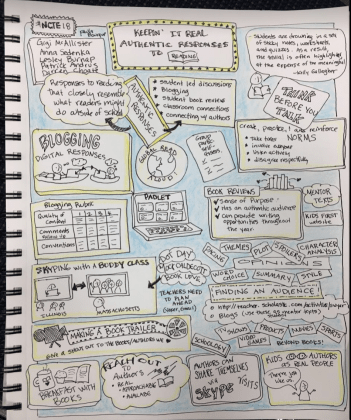
I appreciate that each of these panelists (several from Maine) are in the classroom everyday and using these practices.
Though many were not new ideas they offered ideas for rubrics and reflection that teachers could use in assessing student responses that are more authentic than tests, quizzes, and response logs.
They reminded us that we can’t just assign these approaches, but that we have to explicitly teach students how to use them, and scaffold them as needed. If kids aren’t ‘getting it’ then it is on us to reteach, provide feedback, and model for them.
Writers’ Notebooks: Who? What? When? Where? Why?
 Michelle Haseltine, Linda Urban, and Amy Ludwig VanDerWater are my go-tos when it comes to writers notebooks, so when they were scheduled to present a session I was gobsmacked!
I love the idea that our notebooks are gifts to our future selves. Author Anne Nesbet talked about this in a session I moderated as well. She suggested entries and documents that balance LARGE (world events) with LOCAL (community or personal) to write about.
Also-don’t be intimidated by perfect- be messy and raw. These aren’t published pieces they are an exploration of our heart and soul on paper. Surprise yourself!
There were more take-aways that I’ll explore in future posts, but these were some sessions that will resonate with me for a long time. Of course, the sessions I presented with others shaped my teaching in profound ways as I prepared, reflected, and practiced more mindfully what I planned to ‘preach’. You can see those presentations here:
https://www.paulabourque.com/ncte-2018
Anytime we plan to teach others, we enhance our own practice and deepen our own understandings. If you have never thought about being a presenter, I would strongly encourage you to try it. You will definitely come away a stronger teacher and more reflective practitioner. Call for NCTE 2019 proposals are open now https://convention.ncte.org/2019-convention/call-for-proposals/
One More Off My TBR Stack!

SHOUTING AT THE RAIN by Lynda Mullaly Hunt
I have been waiting so long to get my hands on this book and all I can say is that it’s worth the wait!
Lynda Mullaly Hunt actually threw out her first manuscript and started all over with a new setting-Cape Cod and the story poured right out of her heart and onto the page.
We meet Delsie living on the Cape with her Grammy, abandoned by her mother and never knowing her father. Until this summer she has never given the situation much thought, but as some friends rehearse for Annie at the summer playhouse, she realizes she, too, is an orphan. She feels an even keener sense of loss when her best friend, Brandy, chooses a self-centered summer visitor, over their longstanding friendship. Along comes a new kid, Ronan, who is sharing some of the same struggles as Delsie, but handles his frustration in more destructive ways. Together they confront challenges we hope our children never have to weather, and make some discoveries about themselves and what family really means. So glad I finished this on Thanksgiving-a perfect way to celebrate the day!


 litcoachlady