Monthly Archives: October 2019

Kindling Joy and Thinking in Emergent Writers

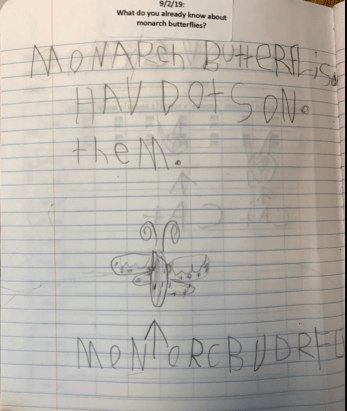
In my book Spark! Quick Writes to Kindle Hearts and Minds in Elementary Classrooms I share sparks for some of our youngest writers with the idea that we meet them wherever they are in their writing development. For some that may be at a drawing or a label stage of early writing. For others it may be at a word or phrase level. Too often writing is often seen as legitimate and “real” when it conveyed at a sentence level. But if we limit our definition of writing to that advanced stage we are in danger of missing out on some powerful messages being conveyed and limiting the exploration of thought that can happen with the smallest of pencil strokes.

In my district there are two first grade teachers who have made daily quick writes a routine with their students. The “Sparks” they offer may be pictures and images, a single word, or a question to stimulate their thinking. To make it easy and accessible for all students they have used labels to print the verbal (written) sparks so that students don’t feel the need to copy over those words before diving into their own writing responses.

Screen Shot 2019-10-26 at 7.36.10 AMScreen Shot 2019-10-26 at 7.36.27 AMScreen Shot 2019-10-26 at 7.36.35 AM

These short quick writes are not just about transcribing responses onto a notebook page, they are opportunities to activate thinking, and sometimes emotions, as students contemplate what they know or what they believe. Yes, they are getting practice with encoding letter sound correspondences, but they are also playing with encoding as the process of actively relating new information to knowledge that is already in memory as they respond to each spark.

Here’s what these teachers had to say about quick writes with their first graders:

Since starting Quick Writes in the classroom this year, I notice my students can start writing right away knowing they only have 5 minutes to write. Most of them started with pictures first and now they are writing words. I see their confidence growing in their writing… they are no longer saying, “I don’t know what to write about,” they just write. As the teacher, I am learning a lot about my students in just 5 minutes of writing daily.”Maureen Cooper

Screen Shot 2019-10-26 at 9.31.29 PMI think Quick Writes are having a very positive impact on my students’ ability to write joyfully and without the worry of someone critiquing their writing. I’ve seen their creativity emerge during this time as they are able to respond to a prompt in any way they choose. I have also noticed that ALL of my students (every single one) are excited to share their quick writes with each other when writing time is over and they all have the confidence to share their writing in front of the whole class. Quick Writes have really helped even my most reluctant writers find their voice and share it with others.” -Kate Parker

I believe Quick Writes are a perfect way to empower writers of all ages, and I encourage teachers not to wait until they are “writers” before starting. When we redefine what writing is to encompass all marks that convey meaning, we can see all of our students as writers and we can ignite a writing passion early in their school careers. If you use Quick Writes with your emergent writers I’d love to hear from you.  Let’s spark joy, thinking, and creativity with more bursts of low-stakes writing for all students.

One More Off My TBR Stack

Screen Shot 2019-10-27 at 10.51.09 AMThe Mad Wolf’s Daughter by Diane Magras

WOW! I loved this medieval adventure for so many reasons. Diane Magras (Maine author) has given us a heroine we all need to cheer for-12 year old Drest is the youngest child of the Mad Wolf of the North, and when he and her 5 brothers are captured by invading knights and taken away to be hanged, she is the only one who can save them. She brings along a wounded enemy knight with her, who she plans to exchange for one of her brothers. But she encounters much danger along the way and is spurred on by the voices of her brothers in her head when she most needs their advice and encouragement. Drest also learns some hard ‘truths’ about her warband family that she wrestles with as she tries to make them proud, but also do what she feels is right in her heart. Her quest will keep readers riveted and they’ll be happy to know a sequel awaits them. I listened to the audio book narrated by the incredible Joshua Manning and it was fantastic! His Scottish voices brought each character to life so vividly. If you love a good adventure, do NOT miss this 2019-20 MSBA nominee! (Oh, and I equally love the sequel The Hunt for the Mad Wolf’s Daughter!)


When Curriculum Becomes Life or Death Learning

This week we had a day and a half of professional development in our district. For some of that time we broke into teams and groups to work on curriculum and to share ideas on pedagogy, resources for implementation, and time for collaboration. We want to make sure our instruction is meeting the academic needs of all students and take that work seriously.

Then we focused on a side of education we rarely discussed at the start of my teaching career: the social-emotional needs of our students, in particular those who have experienced trauma and at risk for harming themselves or others. This was painful for us as teachers to explore, because we know how painful it is for our children who are experiencing this in their young lives.


We first had a training on “Understanding and Responding to Child Sexual Abuse”. When you hear 1 in 5 people are involved in sexual violence in your state, and you look out at your classroom to the faces of those 20 or more children, you know the odds and it breaks your heart.  I’m certainly going to spend some time on the Children’s Safety Partnership website this weekend to become more familiar with their resources.

img_3550img_3551


I kept wondering how many of our children struggling to follow rules, engage in our lessons, treat others kindly, or control their behaviors are dealing with trauma we could never imagine? How do we teach them when their little hearts and minds are so wounded?


Then we had a training session on Suicide Prevention. We learned that our state has one of the highest suicide rates in the nation and that suicide is the 2nd leading cause of death for 10-24 year olds!

We (teachers) might be one of the most protective factors for our students in  preventing suicidality.  Our relationships and connections with our students may be a lifeline we don’t even know we are throwing out. 

img_3561


img_3563


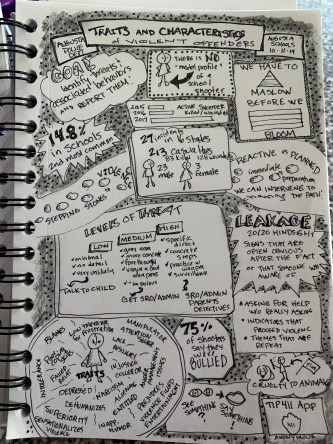
The last session of the day was exploring the “Traits and Characteristics of Violent Offenders”- in other words, those who have carried out mass shootings .

Our local police department prepared a presentation that helped us recognize these traits but were careful to say there is NO “model profile” of a school shooter.

The term that stuck with us was “leakage“-signs that are red flags or indicators of threat that offenders put out ahead of their violent acts, but are often only recognized in hindsight.

Sandy Hook Promise has put out some great videos to raise awareness with this issue.


So being a teacher these days is not only about ‘Readin’, Ritin’, and ‘Rithmetic. Those 3Rs are competing with Social Emotional Learning  and truly life or death issues for our students. Later this month our state test results will be released and there will be cries from the communities for us to raise those scores and work on school improvement plans. Luckily our state has done away with school “Report Cards” that shamed us on these high stakes tests and would have tied them to our teacher evaluations. But the pressure is on teachers to transform lives both academically and social-emotionally with less and less resources.

Am I saying we should lower our expectations? NO WAY! I am saying we should increase our society’s expectations for raising and supporting our children. It needs to be an “All Hands on Deck”, “It Takes a Village”, “No Child Left Behind” mentality from our entire society. It takes money and resources and a real understanding of what schools are being asked to do. We will never be able to attract the best and brightest to become teachers in the future if we blame schools and teachers for every failure, if we don’t have competitive salaries that will draw and keep educators in this difficult profession, if we underfund resources by diverting them to private schools, and we throw around flip and ill-informed comments like, “We can’t throw money at all our problems.” Education is a piece of the puzzle, but so is health care, nutrition, mental health resources, and child care. Accountability is often laid solely on the shoulders of schools. This must change.

I go to work each week grateful for the teachers who return each day to their classrooms with a passion for what they do. They are making a positive difference in the lives of children, no matter what their MECAS score tells us. This weekend many of them will be contemplating the depressingly serious professional development we just had, I’m glad we have a long weekend.

One More Off My TBR Stack

THEY CALL US ENEMY by George Takei, (with Eisinger, Scott & Becker)
This graphic novel memoir by actor/activist George Takei (Sulu on Star Trek) takes us back to WWII when every person of Japanese descent in the west coast was rounded up, taken from their homes, and forced into “relocation centers”. They lost everything (homes, businesses, jobs…) and were held for years in camps with armed guards. This was America and these people were Americans. How could this happen? Could it happen again? As Mark Twain once remarked, “History doesn’t repeat itself but it often rhymes.” Timely, powerful, and important memoir told in an engaging and accessible format for readers

World Teachers Day- So What Are You Doing?

screen-shot-2019-10-05-at-8.34.36-am.png

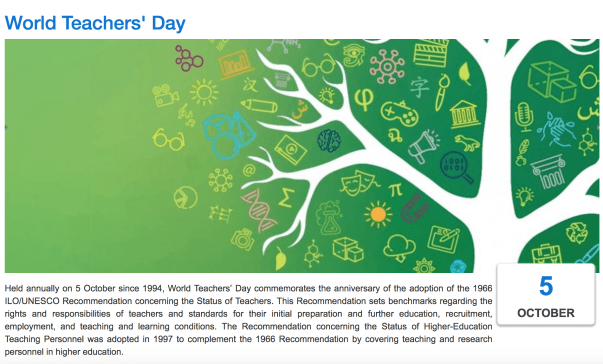
This World Teachers’ Day will celebrate teachers with the theme, “Young Teachers: The future of the Profession.” How fitting for me and my district as we have a large wave of novice teachers this year. Their enthusiasm and passion those first few weeks has been inspiring, and as we enter the second month of school the stresses and strains of finishing assessments, writing goals, setting up parent conferences, and starting RTI plans for students on top of dealing with some unprecedented behaviors are beginning to take their toll on many.

Teaching is hard, even for veteran teachers, and when your tool kit is stocked with the most basic supplies from your pre-service training it is often downright overwhelming. I’ve been trying to meet and collaborate as much as possible with our new teachers and I wish I could clone myself to be there more often. But what I have seen lately is so encouraging: colleagues, mentors, and partner teachers stepping up to support these novice teachers; putting in extra hours and energy to help them be successful.

Some of these partner teachers have always worked with veterans with whom they could collaborate or lean on, and now they are taking on that role for their peer. That is something I don’t think we can appreciate enough. Every teacher who teams with a new teacher is taking on an extra load of work. Even when it is gladly and willingly done, it is still more work that isn’t compensated and rarely recognized.

There is not always a lot of support outside of the school (though we are sometimes blessed with amazing parent groups and donors) so we must usually look within our ranks for that support. So what can we do to be supportive colleages?

For new teachers:

  • Volunteer to take a duty every once in awhile so they can catch their breath and catch up on the ever-growing “to do” lists.
  • Drop a note of encouragement on their desk or in their mailbox (and a piece of chocolate makes it even sweeter)
  • Give them specific feedback on something you notice that is working. Often we give them advice for what might be problematic, but we all crave that feeling of competence.
  • Offer a space in your room for students who need a time-out. It can make a world of difference for that teacher to know we are all in this together.
  • Ask them, “What went well today?” to help them to focus on the positive, it’s too easy to perseverate on our ‘failures’ and challenges. We sometimes need a reminder that good things are happening in our classrooms.
  • Create a care package at different times in the school year that are predictably challenging. (Some Tums, Advil, Vitamin C, Chocolate, or gift cards would be so appreciated)
  • Try to remember they aren’t familiar with our institutional knowledge and routines-check in with them after staff meetings or workshops to see if they have questions, concerns, or confusions they may not have voiced in a group.
  • Try to get to know them, or spend time with them, outside of school. Teaching is a lifestyle and not just a job. The happiest teachers are those who have found a tribe to laugh with and lean on in life.

For partner/mentor teachers:

  • Notice and thank those teachers who are partnering with a new teacher– recognize that their workload has increased significantly.
  • Offer to take one of their duties so they can work with their partner a bit during the school day and not just after hours.
  • Drop them a note of thanks for mentoring our next generation of teachers. We want our profession to stay strong and their role is essential in that goal.
  • Consider getting them a gift card or picking up an extra coffee on the way to work-they aren’t being compensated enough for that extra work.
  • You can never offer too much chocolate!

It’s World Teachers’ Day. Take a few moments to think about our fellow teachers. What is one thing we could do to make the life of a fellow teacher better? Will you do it?

Be the change you wish to see in the world.

Do unto others as you would have them do unto you.

It starts with one thing.

No act of kindness, no matter how small, is ever wasted.

Choose Kind.

IMG_3353

One More Off My TBR Stack

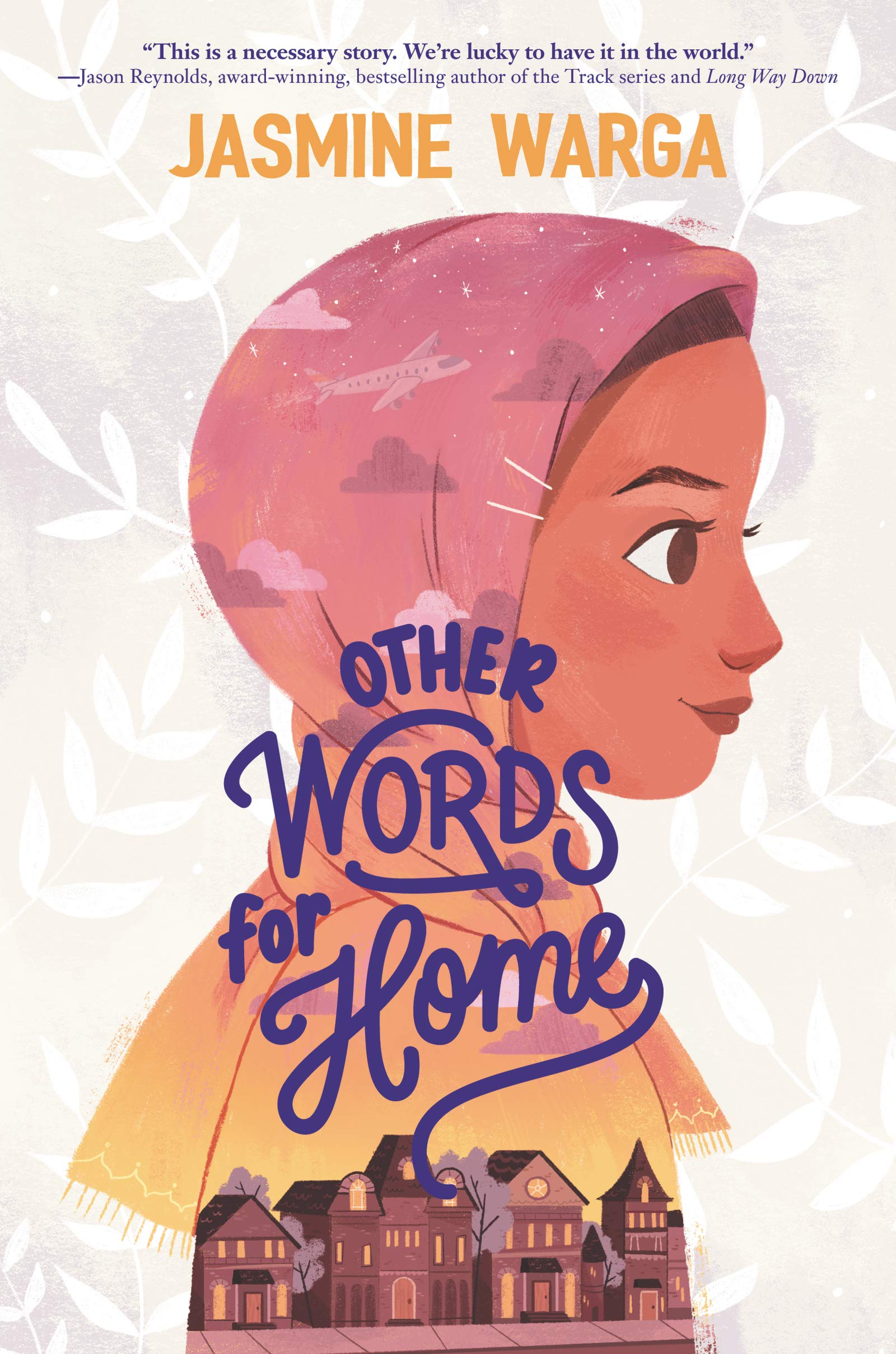
Image result for Other words for home bookOTHER WORDS FOR HOME by Jasmine Warga

This is a story I wish every middle grade student (and their families) in America would read so we would have more empathy, love, and kindness and less talk of “go back home” and “build that wall” when we meet immigrants like Jude and her mother. They come to America to stay with Jude’s Uncle Mazin because her beloved home of Syria has become so dangerous and her mother is pregnant with her baby sister. Uncle Mazin’s wife, Michelle, and daughter, Sarah, are not Syrian (and Sarah becomes jealous that her father is giving Jude so much attention.) What does it feel like to walk in the shoes of someone fleeing violence and coming to America for comfort and safety, only to experience xenophobia and islamophobia that you struggle to understand? A much needed book that tears down the walls of “otherness” and helps us to see we aren’t as different as some would pretend us to be. A beautifully told novel in verse that will open hearts and minds.

Every Child Can Write Blog Tour Stop 3

I love when a professional book comes along that embraces my philosophy and passionevery child can write for writing with students. I was lucky enough to get an advanced copy of Melanie Meehan’s upcoming book Every Child Can Write from Corwin. One of my biggest beliefs is that there should be a place at the table for all writers and we as teachers have the power to create that space.
As part of the BLOG TOUR for this book (Stop 1, Stop 2) I wanted to focus on Melanie’s insights into environment. As she states, “Environments matter. Instruction and learning happen within environments, and it’s our job to set them up to be as conducive to achievement for everyone as we possibly can.” She shares a message from her 4th grade teacher friend, Missie Champagne, who told her class, “Everything in this room is made for you or by you.” Imagine how empowering that message is for students to hear, that this room is personalized for you! The intentional choices we make to set up our environments might not be obvious to every child-we need to help them see that this space reflects and reinforces the learning and the goals we have for success.

Melanie has 3 big ideas for environment:

  1. Striving writers benefit from an organized environment, and they need routines in order to maintain that organization.
  2. Our classroom spaces should contain only materials that foster student learning and independence.
  3. The more we create, provide, and encourage the use of tools for independence and repertoire, the more learning will happen in our classrooms.

She then meticulously shares ideas for how to set up the environment and create routines that help our students move toward greater independence. She shares tips on how to reduce clutter, maximize the physical space for working, and how to choose materials and tools to promote more self-directed learning.

She really encourages us to look at our classroom through a different lens. Do our spaces reflect our priorities? Would someone be able to recognize our recent learning emphasis? Does this help students learn? Do students know how to use this? DO they use this?  So often we see ideas in other classrooms, on social media, or TpT and wonder if we should try it. Being reflective and intentional in what we want our students to learn and do will guide our decisions regarding environments, and Melanie’s book can help you to become more reflective and intentional.

She also has a chapter on routines that can help you be just as reflective. She has examined some of the roadblocks to independence that inhibit writing and offers some support for teachers.

Melanie has 3 big ideas for classroom management and routines:

  1. Transitions work best when everyone gets to where they belong during instruction and independent writing time.
  2. In order for instruction to be effective, students must not only listen to it, they must understand it.
  3. Independent writing time should involve independent writing.

Now you might look at these and think, “Duh, that seems pretty obvious,” but we know it doesn’t always happen, especially for our striving writers. Melanie offers tips to help involve the students in the set up of routines and expectations as well as help teachers anticipate the inevitable challenges and barriers for students’ success. Teachers will definitely come away with more tools in their classroom management toolkits after reading this chapter.

The rest of Melanie’s book offers ideas and inspiration for supporting all writers with many of the “pitfalls and potholes” that inevitably occur, especially for those students who keep you up at night with worry and concern. She’ll help you establish entry points, bridges, and pathways for all writers to succeed.Screen Shot 2019-09-30 at 6.20.00 PM

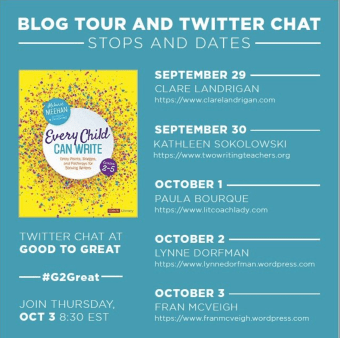
Tomorrow, Lynne Dorfman will continue the conversation as the next stop on the blog tour, followed by  Fran McVeigh. Please plan to join the #G2Great Twitter chat  all about Every Child Can Learn, on Thursday, October 4th at 8:30 EST,.

For a chance to win your own copy of Every Child Can Write, please leave a comment by October 7th. I will use a random number generator to pick the winner’s commenter number.

Please leave a valid e-mail address when you post your comment so I can contact you to obtain your mailing address if you win. From there, a contact at Corwin will ship the book to you. (NOTE: Your e-mail address will not be published online if you leave it in the e-mail field only.)

If you are the winner of the book, I will email you with the subject line of EVERY CHILD CAN WRITE within five days of receipt. A new winner will be chosen if a response isn’t received within five days of the giveaway announcement.