Category Archives: Uncategorized

Teachers Are More Than Scores, Too.

Today, all across the country thousands of teachers are opening their email from National Board and shedding tears. Some of joy. Some of disappointment. Some have been working for years on the four components of accomplished teaching, and some have packed it all into a single year. There is no way to convey the anxiety and anticipation they have been feeling unless you have gone through the process.

Today as I entered my log in information my hands were shaking and my heart was beating in my throat. I tried to steel myself for whatever I would read. I knew how hard I had worked and was proud of my efforts-that wasn’t going to change based on the news today, but I knew the news today was going to change me. I would either be celebrating or game planning-there would be no quitting. The score would no more be a reflection of who I was as a teacher than the standardized test scores of students reflect who they are as learners (and people). Yet they have profound implications in the way others see us.

When I logged in the word CONGRATULATIONS! stopped me cold.  Tears flowed down my cheeks and I began to sob. My shoulders felt instantly lighter and I was euphoric.  After my mini-melt down I immediately began to think of my teaching partners who worked with me on this journey. There were four of us in my district who jumped in together. We helped each other video tape lessons, review our writing, give feedback on our work, and they generously loaned me their classrooms since I didn’t have one of my own. I had gone to monthly meetings sponsored by Maine Education Association for two years and partnered with teachers from across the state. How did they do?

Slowly I started to hear from them. Some shared their sense of joy and relief. Others, their heartbreak.  One missed certifying by ONE POINT.  Part of my commitment to this process was to support others on this journey and so my real celebration will happen when all of my colleagues share the joy I felt today.

If you know a teacher who is working on their National Boards I urge you to offer them encouragement and support. It is an incredibly challenging quest. No one gets there alone-we all need each other.  If they certified today, help them celebrate.  If they didn’t, be a shoulder for them.

To those of you today who opened that email and received your news…I know that you are more than that score. You are courageous and passionate about being a life long learner and you have my respect and admiration.  I hope you are celebrating, and if you are not know that you will be. And when you do, that celebration will be even sweeter.

What’s On My Book Radar?

Screen Shot 2017-12-16 at 9.21.36 AMPASHMINA by Nidhi Chanani

This debut novel by Nidhi Chanani is both modern and miraculous. Priyanka is a teen who lives with her single mother in America and longs to learn about her Indian heritage. However her mother refuses to talk about her past or her homeland. ‘Pri’ discovers a pashmina tucked away in her mother’s suitcase, and when she wraps it around her she is transported to a place she can only assume is India, complete with talking animal guides and a mysterious shadow figure she is determined to identify. Caught in a tug of war between two worlds, two societies, and two identities we get to know Pri and her family. We also learn much about Indian culture and food- which is delightfully delicious! I hope students will love this graphic novel as much as I did. Enchanting!


What #NCTE17 Offered This Teacher

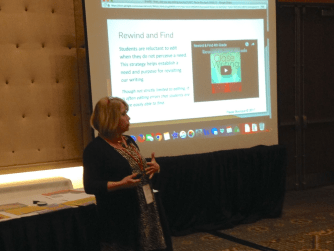
Last weekend I met up with thousands of educators from across the country (and beyond) in St. Louis for the 2017 National Council of Teachers of English Annual Conference with the goal of growing and improving their teaching craft. I met up with dozens of authors who wanted to share their stories and their love for writing and books with the world. Though I paid every penny of my expenses, I realize what a privilege it was for me to be in attendance and I make it my mission to share what I’ve learned and experienced with others. I’ll share a few of those takeaways here in my blog.

screen-shot-2017-11-25-at-7-30-54-am.png

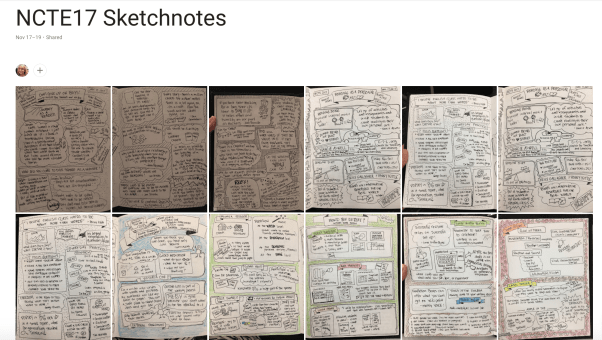
CLICK HERE TO VIEW ALL SKETCHNOTES

For the past several years I have used Sketchnotes to capture the ideas, quotes, and wonderings I find important during the sessions I attend.  You can see these visual notes by clicking on the link above. Here are some of the big ideas I left NCTE17 with…

  • We need to expand the definition of reading and writing.  There is a canon of writing that is too formulaic- and too often we judge texts as “not real reading”. We will invite more readers and writers into the fold if we redefine what reading and writing is.
  • Being a human being in the world is more important than being a reader or writer. If literacy doesn’t help us to explore what it means to be human then it is just an assigned task and not an act of engagement and purpose.
  • Reading and writing is a personal art. Everyone deserves to figure out what process works best for them. Our job is to help them discover this, not just follow our directions.
  • We all have defaults in our reading and writing-that comfort zone we tend to dwell in. When we are aware of them we can more easily break free and expand our repertoire and approaches.
  • Teach with humility. We don’t have all the answers, we cannot be experts in everything. There is so much we can learn from our colleagues and our students if we approach our teaching with an open mind and an open heart.
  • Ask ourselves, “What masks have my students had to wear to exist in the spaces we’ve created?”
  • “The DNA we are walking through this world with is complicated. How do we teach people we consider as ‘others’ when we are the gatekeepers?” –Jacqueline Woodson
  • Before we speak our truth…consider the truth of others. Remember, our identity always comes into the conversation.
  • Consider soft starts to the school day to welcome our students into learning spaces that are inviting, stimulating, and creative.
  • Readers who progress, learn to read by reading.”-Marie Clay  Too often our most struggling readers do the least amount of actual reading. Skill work and interventions replace the reading of continuous texts.  Think about this.
  • Continually ask ourselves: Am I teaching my students or am I covering my material? If we (including students) aren’t clear on expected learning outcomes they’ll just be doing tasks.
  • Books are not diverse if what we mean is they are non-white. That sets up white as the default. What may be a window to one is a mirror to another. Authentic voices are the key to sharing books that promote empathy and understanding.

There were so many more nuggets that I will hold onto (and you can see them in the sketchnotes or photos) but these were what resonated a week out from the conference and so I believe they will stay with me. You can see photos of sessions here:

CLICK HERE FOR #NCTE SESSION PHOTOS

What’s On My Book Radar?

SMART COOKIE by Elly Swartz

My review is from the ARC of this book that will be released January 30th.

Screen Shot 2017-11-25 at 8.34.00 AM.pngFamily secrets and recipes make this one sweet story! Frankie’s mom died when she was 4 and she decides she wants her dad to meet someone who would make them a family of 3 again. She sets up an online dating profile and compiles a list of Possibles who never seem to fit the bill. Meanwhile her dad is busy running a B&B that is losing business because there are rumors it is haunted. This has Frankie wondering if her mom could be a ghost, so she begins writing her letters for advice. And then we have Gram who seems to have secrets of her own and behavior that is becoming more curious for Frankie. There are so many amazing subplots going on in this book, it kept me captivated. (and the descriptions of the daily cookies at the B&B kept me salivating!) Elly Swartz knows how to write complex characters in compassionate and compelling ways. On the heels of Finding Perfect, I think Swartz has found another perfect story!


TOP 10 Reasons Teachers Should Attend Regional/National Conferences

NCTE (National Council of Teachers of English) conference is coming up this week in St. Louis. Many teachers across the country will be going to share in the experience, many more will not. Trying to convince schools that this is a smart investment for them is often difficult. Here are some reasons I recently shared with my school board, I’d love to hear others. If you are one of the lucky ones who can attend these conferences, be a voice of advocacy for your colleagues and a testament to the power of professional development.

Don’t forget turn back around
Help the next one in line
Always stay humble and kind

1.Meet experts and “gurus” face to face

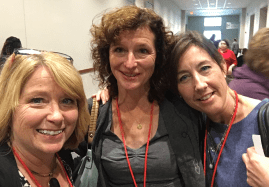
The authors and experts we learn from in professional texts are accessible and open to Screen Shot 2017-11-11 at 8.16.20 AMcollaborative conversations at these events.  There are opportunities for Q&A, meet and greets, book signings, and just running into them in a convention center.  Teachers will be empowered to see that these “experts” are teachers themselves, who have taken their passions to the next level.
  1. Exposure to cutting edge research and state of the art teaching.

Presentations at these conferences are the latest in research, instruction, pedagogy, assessment, and organization. They’ve been vetted by a review panel and needed to pass an array of standards for quality, so we can trust the validity of the information.  Education is constantly changing, and our teachers and schools should have opportunities to learn and adapt.

  1. Networking

Meeting people from other states, regions, or countries can expand our understanding of education like no other experience. We often realize we are more alike than we are different, and yet we each have unique challenges and gifts that make educating America’s youth more than a “one size fits all” reform initiative. We can make lifelong connections to people who will inspire us, support us, and teach us on a personal level.

  1. Break out of your comfort zone

Traveling to a new place can be somewhat stressful, but also exhilarating. Understanding what life is like in unfamiliar surroundings can be eye opening. Learning in a new space activates our brains in new ways and offer up opportunities for fresh/flexible thinking. Connecting with people who may teach differently or have varying opinions can challenge our long held beliefs, routines, or values. They can often reinforce them, or cause shifts.  Either way, that cognitive dissonance is essential for growth as an educator.

  1. Enhance professionalism.

We are treated like professionals at these conferences. Everyone views us as a leader in our field, someone willing to devote days of our busy lives to focus on being the best we can be. Presenters, organizers, and vendors show gratitude and respect for the hard work that goes on each day in our classrooms. There is a shared sense of purpose, empathy, and camaraderie with other professionals in the field that enhances our sense of professionalism for a long time to come.

  1. Intense focus on learning

Much like immersion in a language, teachers are immersed in a focused purpose of improving teaching and learning. We eat, breathe, and live teaching the entire time we are attending a conference. Dinner conversations are often continuations of the day’s learning. We are infused with ideas, energy, passion, and encouragement.

  1. Empowered by like-minded and passionate professionals

We are surrounded by “nerdy” teachers that feel like our TRIBE. There is strength in numbers and we definitely leave a conference feeling stronger because we know we aren’t alone in our passion. We can appreciate that the dedicated teachers we work with each day are just like teachers all across the country and our shared purpose feels empowering.

  1. Expand circle of leadership

When teachers go to a conference and come back to share what they’ve learned and experienced, they are seen as leaders who are willing to give back to their schools.  They aren’t hoarding their new learning, they are expanding it exponentially. It builds expertise in our schools that broadens our resources for supporting one another.

  1. Invest in Our Teachers (and Ourselves)

Teaching is an exhausting profession in which we give and give and give each day. If schools don’t invest back into our teachers, we are draining a precious resource.  Even if a district is paying expenses for attendees there is an incredible personal investment of time and energy. Teachers often have to rearrange their home lives and responsibilities to make accommodations. There are always unreimbursed expenses incurred that have a financial investment required. Teachers do this anyway, because we see it as an investment in our skills, motivation, and passion. If teachers are willing to make the investment, our schools and communities should, too.

  1. Invest in Our Students (Our Kids Are Worth It)

Speaking of investment…aren’t our kids worth the best trained, most motivated, incredibly passionate teachers we can give them? Don’t we want them to have teachers who are dedicated enough to devote days of their lives to make their learning better? Don’t they deserve to have the most cutting edge assessment and instruction to facilitate their learning. It doesn’t just happen by luck, we need to cultivate it and make it a priority.  Remembering why we are here and doing what we do, it makes sense to make sure our students have the best teachers we can give them.

BONUS

And then when your teachers ARE presenters it can be even more powerful:

  1. Build ExpertiseScreen Shot 2017-11-11 at 8.13.29 AM

If you’ve ever had to share information or expertise with a group of smart individuals, you know you need to bring your A Game-there’s no “phoning it in”.  When schools send teachers to present at conferences they are supporting a teacher to hone their skills to the highest degree. Teachers put in countless hours in observing, writing, reflecting, and revising. This level of self-reflection builds increased expertise that no other professional development can.

  1. Bring Prestige for Our Schools

When presenters share the excellent work that is going on in their schools, they are showcasing the talents and successes that have been hard won. They shine a light on our teachers and students for others to celebrate and learn from. They are passionate ambassadors for their schools-more powerful than a public relations firm! Conference participants often want to connect with the teachers from our district and network to build greater capacity. It draws us into membership of a learning community larger than ourselves.

I’d love to hear even more ideas that support greater teacher participation as well as ways districts help to fund this as well.

What’s On My Book Radar?
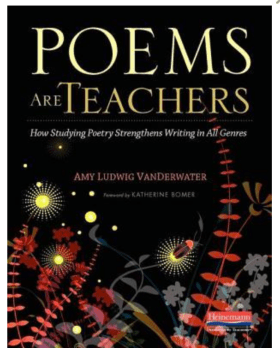
Screen Shot 2017-11-11 at 8.00.01 AMPOEMS ARE TEACHERS by Amy Ludwig VanDerWater

I have been so excited for this book’s release and when it arrived I devoured it. Amy Ludwig VanDerWater has been my “go-to” poet/teacher for years. Her website The Poem Farm http://www.poemfarm.amylv.com/ has helped me teach and think about poetry in new ways so I knew this book would be amazing–and it didn’t disappoint. Each lesson offers us 3 poems as mentor texts (1 contemporary poet and 2 student poets) for learning about: craft, ideas, point of view, structure, titles and more. You do not have to read it cover to cover, just dive in and enjoy. Your teaching of poetry will be inspired and your appreciation for poetry will be enhanced. It’s amazing.

We’ve Got the Power

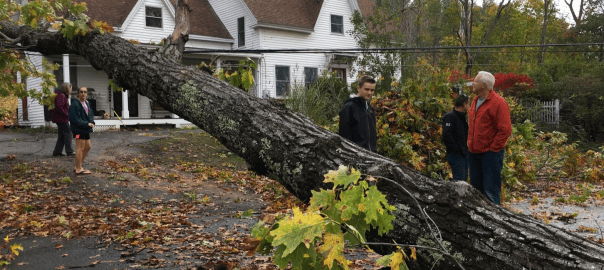
This past week Maine was hit with a powerful storm that left us powerless! It knocked out power to over 1,500,000 homes and businesses.  We were caught off guard by its magnitude.  The drought we’d experienced this summer weakened the roots of many trees that were still heavy with foliage and as a result thousands of trees were toppled, taking utility poles and wires down with them.

Schools across the state were shut down anywhere from a day to a week. We are a rural state, so many were also without water since well pumps rely on electricity.  For many of our students school was the only warm, lit place with food and water. Many of us teachers found our schools a place to clean up, charge electronics, and commiserate with one another.

As difficult as these days were, many of us found an incredible silver lining. In a time Screen Shot 2017-11-04 at 7.56.37 AMwhen discourse and interactions have been so polarized, we saw an incredible coalescing of community. Those with power opened their homes to others for a place to shower or get a warm meal. Schools opened showers to community members and offered charging stations for devices to keep people connected.  Restaurants and stores provided free warm meals to anyone in need. Words of encouragement and support sprouted up on social media. People expressed happiness for others as they celebrated the return of power, even though they may have been in the dark themselves.
In a 5th grade I was working in this week I asked the students to quickwrite a response to the statement The storm was actually a good thing. Nearly every response refuted the statement until we shared and reflected. At that point, many students began to share some wonderful moments they had with their family or friends. “Well, actually it WAS good because we got to go to my memere’s. and Oh, yeah…we got to go out to eat, that was fun! and We got to read with flashlights.” Many also talked about how happy they were when the power came back on, and that felt really good.

Empathy. Appreciation. Community. These were gifts that the storm left in its wake. I hope that in this season of giving thanks that we will continue to hold onto these. We can nudge our children to think beyond the frustration of events, to contemplate the gifts or lessons that every experience offers us. We’ve got that power.

What was lost Is foundNot in the flick of a switch But in the beat of a heartNot in the gleam of a light But in the glow of a deedNot in the absence of heatBut in the warmth of a wordWe

What’s On My Book Radar?

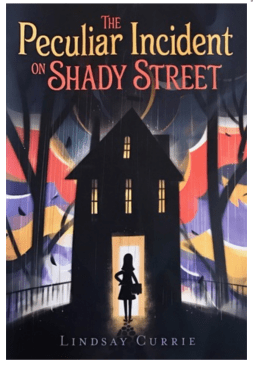
Screen Shot 2017-11-04 at 8.08.21 AMTHE PECULIAR INCIDENT ON SHADY STREET by Lindsay Currie

The perfect way to cap off my Halloween, reading a chilling ghost story. Weaving modern day tween troubles with the macabre mystery of a returning ghost of a long dead child, Lindsay Currie has created a creepy, yet empathetic story kids will love. Tessa Woodward moves with her family from Florida to Chicago when unexplainable things start happening in her new house: drawings appear, her brother’s doll begins crying, and things are disappearing. With the help of three new friends they embark on a quest to solve the mystery of what happened in her house on Shady Street many, many years ago in hopes that some normalcy can return to their lives.

Getting Sketchy at Literacy for All

Last weekend I participated in the Literacy for All Conference in Providence, Rhode Island. Organized by Lesley University in collaboration with the University of Maine and the University of Connecticut, there were more than 100 workshops available to educators.  I was a featured speaker who presented 3 of those workshops, so I was a little more limited on what I could attend, but I wanted to make the most of my time at this fantastic conference.

I was able to see keynotes by Kelly Gallagher and Stephanie Harvey and featured sessions by Penny KittleKate Roberts, and Georgia Heard. I left inspired and energized by their advocacy and passion for literacy.  You can check out my Google Album of photos from these sessions. Don’t pass up a chance to hear them speak if you can!

This is the third year I’ve been using Sketchnotes to capture the big ideas and take aways that I want to return to and reflect on more deeply when I attend conferences.  Before that I would take copious notes, but rarely revisited them-also the act of trying to capture everything verbatim was an exercise in memory control and not in visualizing and conceptualizing what the speakers were saying.

Now, as I hear speakers present ideas, I am visualizing their essence and quickly sketching images or jotting phrases. I think about how ideas connect and build on each other. Instead of a linear set of notes I have a more dynamic collection of take aways. I know that if I want more information I can read their books and visit their websites. I don’t feel the pressure to capture it all.

You can see my collection of sketchnotes from the conference in this Google Album.

Screen Shot 2017-10-29 at 8.16.36 AM
Paula’s Sketchnotes from Literacy for All Oct. 21-23, 2017

Each year I see many more teachers taking visual notes (aka Sketchnotes) at conferences.  I am excited that they are finding this approach to be a helpful way to process the information in a personalized way.  Perhaps I will ask others if I can share some of their sketchnotes in future blog posts. If you use Sketchnotes, drop me a line!


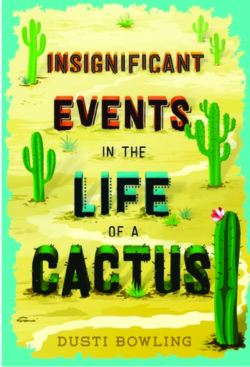
Screen Shot 2017-10-29 at 8.42.51 AM.pngINSIGNIFICANT EVENTS IN THE LIFE OF A CACTUS by Dusti Bowling

Middle school is hard enough, but imagine trying to make your way with no arms, or with debilitating Tourette’s Syndrome. Top that with moving to a new school in the middle of the desert. That’s the situation for Aven, an amazing girl who just happened to be born without arms and her friend , Connor, with uncontrollable tics. Together with their new friend Zion they form a friendship that helps them solve mysteries, take risks, and feel accepted. I just couldn’t put this book down! If you are looking for books that encourage empathy and compassion, that have strong characters who just happen to have disabilities, and want an engaging plot to pull in readers-you NEED this book in your classroom!


#Why I Write

October 20th was the National Day on Writing sponsored by NCTE. As their website says, “Every October 20, NCTE celebrates the importance, joy, and evolution of writing through a tweetup, using the hashtag #WhyIWrite and events hosted by thousands of educators across the country.” The belief is that writing is critical to literacy, but also to our quality of life. Raising awareness and appreciation for the role that writing plays in our lives is the goal of this event. This year NCTE created a new page WHY I WRITE to spread the conversation.

Teachers at my schools posed the question, “Why do you write?” to their students and got wide ranging responses, many predictable, some unexpected.  A second grade student shared, “Writing calms me down.” demonstrating a benefit to writing that cannot be measured by assessments!

I saw countless  responses on Twitter with the hashtag #WhyIWrite that helped me appreciate writing even more than I already do. Some were humorous, many were passionate, all were personal.

This week I will be a featured speaker at the Literacy For All 2017 Conference in Providence, RI. One of my sessions will be Who Says We Don’t Have Time To Write? designed to encourage and support teacher writers. I know those in attendance will most likely be the choir I will “preach” to, but I hope they can bring back some inspiration to their colleagues to inspire them to be writing teachers.

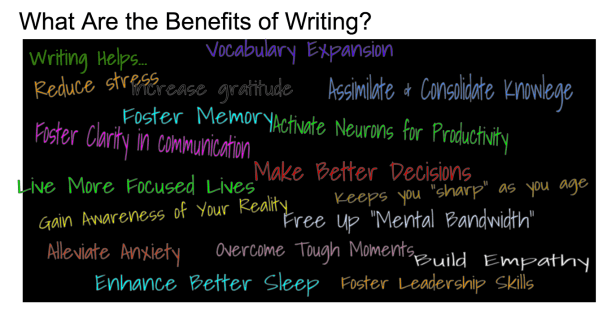
One aspect I will be discussing is how writing can enhance our lives beyond the classroom:

Screen Shot 2017-10-21 at 7.43.51 AM

I mean, who doesn’t want these benefits?

I will also offer a Padlet of resources they can reference and share with colleagues that can offer ideas, tips, and inspiration.

I want teachers to reflect on Why I Write beyond October 20th each year and appreciate the important role writing can play in our lives each day. I hope that other teachers will spread the love of writing to students, families, and colleagues as well.

What’s On My Book Radar

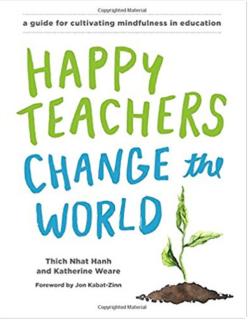
Happy Teachers Change the World by Thich Nhat Hanh and Katherine Weare

Screen Shot 2017-10-21 at 8.02.02 AMI have been building a practice of meditation and mindfulness the past few years and trying to bring that practice into my teaching and coaching. So I was thrilled when I saw my hero Thich Nhat Hanh and teachers from his Plum Village in France had authored a book with this very focus. Though I have just started it, I wanted to share this as a resource that could benefit every teacher. As their website says, “The instructions in Happy Teachers Change the World are offered as basic practices taught by Thich Nhat Hanh, followed by guidance from educators using these practices in their classrooms, with ample in-class interpretations, activities, tips, and instructions. Woven throughout are stories from members of the Plum Village community around the world who are applying these teachings in their own lives and educational contexts.” The practices start with ourselves and then extend to our students and classrooms in purposeful and mindful ways. If you are looking to bring more mindfulness into your life, this book could be the gift you deserve!

Hopes vs. Goals

Next Monday in our district, teachers must turn in their goals to their administrator. Our state (Maine) has adopted PEPG (Performance Evaluation and Professional Growth Model) as a tool for evaluating teacher effectiveness. Teachers must write 2 Goals

  • Professional Goal (for personal growth)
  • SLOs -Student Learning Objectives (for student growth)

Our district has chosen NBPT Standards (National Board for Professional Teachers) for professional goals. Teachers must first self-assess their strengths and weaknesses on each of the 5 Core Propositions of the NBPT Standards and then select an area of weakness to design a goal.

Then teachers must determine an area of need for their students based on a variety of data including: reviewing student folders from previous years, current student work, IEPs, pre-assessments, standardized tests, etc. They then set a goal for student learning that addresses the need they’ve determined.

Simple right? Well, it might be if all students had the same strengths and weaknesses. It might be if students were only weak in one subject area.  It might be if they all had a similar weakness in one aspect of that subject area. Our students, however, tend to come to us with a beautiful tapestry of abilities, interests, motivations, and personalities that can make singling out a goal an interesting task.

This is where the math coach I work with and I come in.  We have been helping teachers:

  • Reflect on  student work
  • Analyze student data from pre-assessments or standardized tests
  • Compare student abilities to end of year expectations
  • Prioritize those expectations (what do you want all __graders leaving your class being able to do as a_____(reader, writer, scientist, mathematician, etc)
  • Draft a goal that is achievable but rigorous
  • Create plans of action for instruction that targets the goal and differentiates for students.

That is goal setting and it takes a lot of work.

HOPES

In the past few years we tended to write more HOPES than GOALS. We might have written “At least 80% of my students will go up 1 level on the Fountas & Pinnell  Benchmark Assessment”. We had no plan of action for making it happen other than our regular teaching so it wasn’t so much of a goal for the students as a hope that they hit the expected benchmark. It wasn’t stretching our teaching or their learning in any purposeful way. It didn’t offer a path for success. And our hope for their success relied on one assessment measure at the end of the school year. If they had a bad day, if they didn’t connect with the test book, if they made some careless errors, our hopes were dashed.

GOALS

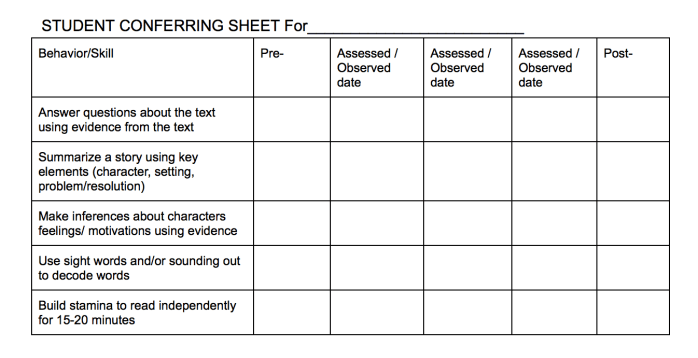
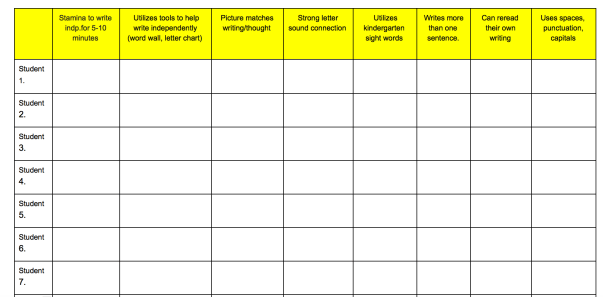
This year I have asked teachers to look at the reading (or writing or math) behaviors expected for those end-of-year benchmark levels and pull out the ones they determine to be non-negotiable. These are behaviors they want students to leave their class with  solid ability. We created a rubric of these 5-10 behaviors and created a class roster in which we could track success with these behaviors and note who already had these as a strength. Their goal might be framed “80% of my students will acquire 4/5 targeted behaviors“. The expectation would be all students acquire all behaviors but we have to be careful with our wording. The way the teacher evaluation system works, if they don’t meet the goals the way you’ve written them-you are ineffective!

Here are some samples from 2nd Grade and Kindergarten:

Screen Shot 2017-10-14 at 8.26.14 AM
Individual Tracking Sheet for Each Student
Screen Shot 2017-10-14 at 8.20.59 AM
Class Roster for “At A Glance” Tracking

With these tools, teachers can more easily differentiate instruction as they create small groups and confer with students.  They can decide when whole group lessons need to be repeated and refined, or when it would be more efficient to form small skill groups.  They can see who needs more scaffolding and who is ready for more challenge. This type of goal setting drives instruction. Students and teachers are more actively pursuing their goals. They aren’t merely hoping they pass the “Level N” book in June.

How does your district set goals? Do you find them meaningful? I’d love to hear more.

What’s On My Book Radar

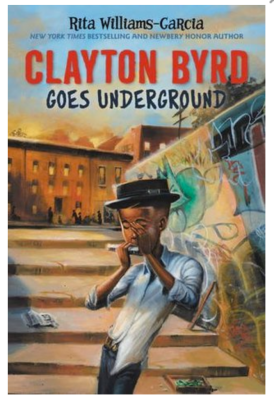
Clayton Byrd Goes Underground by Rita Williams-Garcia

Screen Shot 2017-10-14 at 8.39.26 AMI need more books in my life that expand my understanding of the human experience-and this short but powerful novel did just that. Clayton is learning to play the Blues with his grandfather, Cool Papa Byrd. He wants nothing more than to please his Papa and be ready to solo-and then his world is turned upside down. Papa Byrd dies and Clayton’s mother sells everything he owned and promised to Clayton-including his guitar. Devastated, Clayton steals back his grandfather’s pork pie hat-the only memento he has left. We begin to see the tangled relationships between Clayton’s mother and her father, between Clayton’s mother and his own father, and Clayton’s relationship with the two of them unfold. All families deal with loss and grief with some universal feelings, but unique reactions. This book helped me see inside the heart of a young boy, his wounded mother, and the role Blues played in their lives
 

The Power of Story

Working in schools I frequently hear comments like, “We don’t need to focus so much on narrative writing anymore.” or “We need to do more informational and argument writing.”  And while it is true that we want our students to become stronger writers of informational and persuasive pieces of writing I believe the best way to do that is by learning to craft a powerful story.

“One death is a tragedy; one million is a statistic.”- Joseph Stalin

 When we read informational texts that focus on a collection facts and  dates we are not enlightened to the events, we are merely aware.  When we read articles or opinion pages that toss out statistics to persuade us, we don’t empathize, we anesthetize. We can become overwhelmed and retreat to our current, comfortable stance.
Think about the news stories coming out of Syria with the statistics and facts of the civil war going on there. We cannot grasp the intensity or importance of the situation when we are inundated with numbers. But then we see the image of Omran Daqneesh-or as he is better known-the boy in the ambulance in Aleppo. People all over the world want to know his story. The crisis becomes real-the pain becomes comprehensible, the civil war becomes visible.
“Stories are about 22 times more memorable than facts alone.” -Jerome Bruner
This isn’t only true about tragedy and crisis. We can see this this when children read/witness the story of one caterpillar becoming a butterfly rather than reading an informational text about the stages.   We see this with the classic School House Rock video I’m Just a Bill. that tells the story of how a bill becomes a law. We can read the congressional process in a text and recite the steps, but when we see the story of “Bill” we comprehend the process in a whole new way.
Think about how you come to learn anything, and you will probably find that a story helped you to conceptualize and internalize that information into meaningful understanding.
So before we decide we should spend less time teaching narrative writing in our schools, let’s consider how we could extend narrative writing into any and all modes of writing. Let’s expand our definition of narrative writing to move beyond personal narratives and creative short stories, to include narratives that illustrate concepts and positions that inform or persuade. Look at the news clips, magazine articles, and informational texts that surround us and you will see story at the heart of the best of these.

What’s On My Book Radar

Screen Shot 2017-10-08 at 9.45.51 AM

Exclamation Mark by Amy Krouse Rosenthal and Tom Lichtenheld
Though not new (2013) I find myself revisiting this book often.  This week I was working on a PD session for teachers on editing and found this sitting with my books on punctuation.  And it is a helpful mentor text for that, but for so much more. Amy  had a way of bringing story and meaning to life with the simplest of examples. I never thought I would empathize and care about a piece of punctuation- but Amy and Tom did just that. This book is a classic example of how the story of an exclamation mark can help readers understand the concept and purpose of an exclamation mark-(and it discovering our own purpose).

How To Take Charge of Your PD

It can be frustrating as a teacher to participate in professional development (PD) that you don’t perceive as meeting your needs. I’ve been there myself. I’ve come to realize that PD needs to be differentiated, the way instruction for our students needs to be differentiated. Schools cannot meet the needs of every teacher with the limited time and resources they have dedicated to professional learning. As a result, they need to focus on federal, state, district, or school based initiatives-some of which are mandates they have no control of.

So as educators, we need to find ways to take charge of our own PD. Since I have grown my PLN (Personal/Professional Learning Network) I have found so many more opportunities to do just that. Where in the past I might buy and read professional books for myself or wait to see what workshops would be coming to my area-I now have global networks of educators who are literally streaming PD into my life on a daily basis. I am continually inspired, challenged, and excited by the ideas and innovations of my colleagues and will never hunger for professional growth because of them.

Twitter

If you are reading this blog, there is a good chance you are already on Twitter and do not need convincing about how amazing this platform is for building a PLN and growing your PD.  But what about the colleagues in your school who are looking for opportunities to stretch and grow professionally?  It is often very difficult to explain how incredible Twitter can be when what they see is a president tweeting insults to others or Russians using it as active measures to disrupt democracy. Twitter is getting some bad press (and not entirely unjustly) but it remains one of the most powerful tools for bringing ideas and people together.  We need to show, not tell our colleagues how this can put the power of PD into their own hands. Start with

INSTAGRAM and FACEBOOK

Similar to Twitter, other social media platforms can also be a great vehicle for connecting with like-minded or content related educators.  We can easily get “lost” surfing through social media. It is important to follow people who will inspire you so you don’t get mired in drama and minutae if you want to use these as professional tools. Sometimes setting up separate personal and professional accounts can be helpful. Here are a few ideas to get started.

Voxer

This is one area I want to explore more this year.  This is a “walkie-talkie” app for smartphones. Many education chats, conferences and leadership teams now use a Voxer group to collaborate.

EDCamps

As great as virtual communities can be, there is nothing like connecting with passionate teachers in person.  EDcamps are springing up all across the country. These day-long, free professional development conferences are incredible. Last weekend I attended nErDcampNNE (Northern New England) here in Maine.  Not only did I get to learn from amazing kidlit authors and innovative teachers, I had the opportunity to share my own passion and expertise as I introduced a roomful of teachers to Sketchnoting. It was such an empowering experience for everyone. We created our own schedule of sessions from participant requests/suggestions. People stepped up to facilitate and share, then teachers could choose whatever they wanted to see-AND for those sessions they missed, they had access to the Google doc of notes and ideas

Micro Workshops

Even closer to home, is creating professional development opportunities from the wealth of expertise in our own schools.  This year in my district we have had several teachers share their knowledge in after school sessions and opened it up to teachers from other buildings (we have 4 elementary schools in my district).  One teacher shared tips for differentiating with English Language Learners (ELLs) in the regular classroom and another shared how to use ClassDojo to build community and increase communication. We have other teachers who want to learn about SMART boards and DonorsChoose so we will try to set up micro workshops on those topics. I have teachers who have set professional goals on writing, so I am offering a series of micro workshops with strategies from my Close Writing book.  I’d love to say we are paying teachers for this, but our budget doesn’t support it-so we are offering certification credits for those who attend, and extra ones for those who prepare and present. Talk about dedicated professionals!

My point in all of this, is that teachers no longer have to wait for professional development to come to them. They don’t have to bemoan the idea that district PD doesn’t meet their needs. They can be empowered to recognize their own needs and take charge of meeting them-and it can be a lot of fun!

What’s On My Book Radar?

Screen Shot 2017-09-30 at 8.25.47 AM

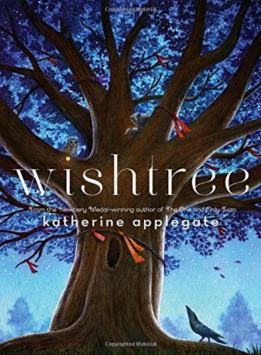
Wish Tree by Katherine Applegate

I have been waiting for this book for months and I worried that after listening to all the hype, I would be disappointed. It’s hard to live up to the acclaim that this book got, but I am thrilled to say it exceeded any preconceived expectations I had! In the same way she created The One and Only Ivan as a beautiful story with a powerful message, she has crafted Wish Tree. Never preachy but truly edifying, Applegate allows us to confront hard truths in gentle ways. In this story, the Wish Tree “Red” has stood for 216 years observing the ever-changing neighborhood. For years  people have tied scraps of ribbon or paper inscribed with wishes on its trunk and branches. When a new family moves in and a young girl shares her wish, Red feels compelled to move beyond observer. I cannot describe how gorgeous this writing is-I savor each line and find myself slowing down to let the words linger. The message contained in those words is even more sublime given our current political and social climate. I cannot recommend this book enough. Truly elevated to one of my all-time favorite books.

7 +1 Steps for the Care and Feeding of New Teachers

I work in four elementary schools as a literacy/instructional coach, and every year we have new teachers (or new to the district). This year we have more new teachers than I can ever remember. Some come with years of experience from other districts, some from other careers, and some right out of college. Supporting them will require differentiation and that can only happen when we get to know them. In the first few weeks I am already able to appreciate the unique gifts each will bring to our schools.

New teachers get lots of advice, not all of it is relevant to their situation, but I won’t let that stop me from sharing what I have found to be helpful in working with new teachers the past ten years.  Here is what I would offer at this time to new teachers. And to those veteran teachers who work with them-think about how we can help in the “care and feeding” of our novice colleagues if/when they take this advice.

  1. Get a mentor.  This could be the one assigned by your school (if your school does this), but you can also find mentors you feel a personal connection with.  Having someone you can trust to go to with concerns will alleviate so much anxiety and help you to focus on what really matters more effectively. It also provides that colleague with opportunities for growth and reflection so it is truly a mutually beneficial arrangement.
  2. Ask for help.  Don’t try to figure out everything on your own-it’s just too hard. Your mentor, your colleagues, your administrator can answer questions that could consume too much of your time trying to solve-and even then you aren’t often sure if your assumptions or expectations are aligned with the school’s. You won’t look ignorant to others, you’ll look assertive and determined to do a good job.
  3. Build a PLN.  A Personal (or professional) Learning Network can be a group of colleagues locally or globally who collaborate to increase our knowledge and agency in teaching more effectively.  Book study groups, grade level teams, or writing groups at your school are examples, but I’ve expanded my PLN with social media (Facebook, Twitter, Instagram) to follow and connect with passionate educators, authors, and school leaders. It has been a game changer. Check out this list of Education Twitter Chats to connect with other educators and get tons of ideas and support. https://sites.google.com/site/twittereducationchats/education-chat-calendar
  4. Don’t get sucked into Pinterest or TpT.  It’s easy to get lost browsing all of the amazing ideas, lessons, and classroom designs on Pinterest- and they can be inspiring.  Just be careful that it doesn’t leave you feeling inadequate or always searching for that perfect idea-you need time to discover who YOU are as a teacher. Take some ideas and play with them, let your own pedagogy emerge through trial and error and reflection.  Your school probably has a curriculum you need to become familiar with before you start buying lessons from TpT (Teachers Pay Teachers). Just because it’s cute, standards based,  or on sale doesn’t mean it aligns with your school’s expectations.
  5. Build Relationships. You might feel overwhelmed with everything you have to do this year and feel like you don’t have time to socialize or make phone calls.  Success as a teacher is built upon the relationships we make with our students, their parents, and our colleagues.  Make those phone calls, send those texts, write those notes to parents before there is an issue. Let them know you are enjoying having their child in class. Mention something you notice about them, ask them what some of their favorite books, activities, or interests are.  You and the parents can become a team.  Get to know your students as children who have hopes and fears, and not just learners. One of my favorite sayings is “Nobody cares how much you know, until they know how much you care.”-Teddy Roosevelt. I have found this to be a truism and there is an incredible amount of research to show the importance of relationships for success in school. Remember, those students who are hardest to love need love the most. Genuine relationships are an investment that pays huge dividends.
  6. Don’t be afraid to make mistakes.  You will!  We all do. Everyday. Some are small and no one else notices, and some are doozies.  Mistakes do not equal failure, they are opportunities to learn and grow. Think about taking a test when you were in school-did you give a second thought to any of your right answers? If you are like me, you zoned in on the mistakes and did some deeper thinking to see where you went wrong. Life is like that-mistakes offer us the chance to reflect and grow. If you haven’t made any mistakes yet, you probably aren’t moving out of your comfort zone-and that’s no way to learn. “Don’t waste a good mistake, learn from it.”-Robert Kiyosaki.
  7. Seek joy.  If you aren’t enjoying what you do, your students won’t either.  Now I realize teaching isn’t a laugh-a-minute, but if you are stressed to the point of unhappiness you aren’t helping anyone.  We often get so busy doing things that we may miss noticing things.  Kids are amusing; they say and do quirky things.  Take time to appreciate that. Laugh at ourselves-hey, as I said before, we’ll make mistakes.  I’ll bet some of them are pretty amusing if you think about it. You don’t have to plan “Fun Fridays” to incorporate more joy into your classroom. If you are looking for ideas, Google “joy in the classroom” and you’ll find tons of inspiration. Learning should not be drudgery. We don’t want compliance from our students, we want engagement. If you find yourself saying/implying “We have to do this.” there is probably not much joy in it.  And then make sure you have time outside of the classroom to pursue your passions, play with your family, feed your soul. We only get one go around in this life-don’t waste it.  When you find harmony between work and play teaching can become a way of life-not a job to deal with.

+1 BONUS TIP- Write about it! -Again, I can appreciate that you are time strapped this year so I am not talking about writing a novel about your first year. What I am talking about is keeping a journal to capture snippets from this year.  You think you will remember everything—you won’t. Unfortunately what many teachers remember are the hard times, the mistakes, and the kids who got under their skin.  There is bountiful research to show that keeping a gratitude or joy journal boosts mental as well as physical health. Writing down questions, concerns, or thoughts frees up mental bandwidth so that you aren’t carrying it around 24/7. I’ll be sharing more about teachers as writers, but for now I invite you to take less than 5 minutes a day to jot down remembrances, wonderings, and joys from your day. Your 2nd year teacher self will thank you!

What’s On My Book Radar?

Screen Shot 2017-09-17 at 8.58.43 AM

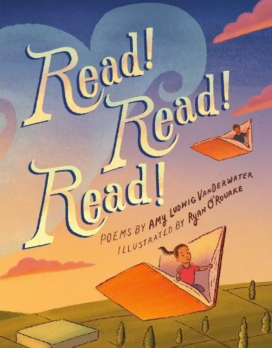
Read! Read! Read! by Amy Ludwig VanDerwater illus by Ryan O’Rourke

I have been waiting, waiting, waiting for this book and I can’t tell you how much I love, love, love it!

Amy has penned a collection of poems to celebrate, inspire, and capture the joys and wonders of reading. I wanted to dive in and devour them all, and now I want to share them with students and give them time to savor each and every one.  Invite them to reflect on their own reading lives through the words of each poem. I definitely think this is a MUST HAVE for every elementary classroom. It is just that good!!