Monthly Archives: August 2020

It Takes a Village, Not Just a School

Screen Shot 2020-08-16 at 6.34.58 AMI head back to school this week and have never worked so hard during my “vacation” to prepare for the start of the school year.

I am reading everything I can on how to be an anti-racist and become an educator who embodies social justice and equity in both my personal and professional life.

I am learning how to use new digital platforms to deliver instruction in engaging and meaningful ways. I know what and how to teach, now it just feels like I have to do everything with my left hand and it is sucking up an incredible amount of mental bandwidth to make that happen.

Teachers across my district, our state, and the country are rolling up their sleeves and doing whatever needs to be done to meet these new challenges-including updating their wills and getting their personal affairs in order. This is not a normal return to school, and tragically for some it will probably be their last. This virus doesn’t care how dedicated you are-just how accessible you are.

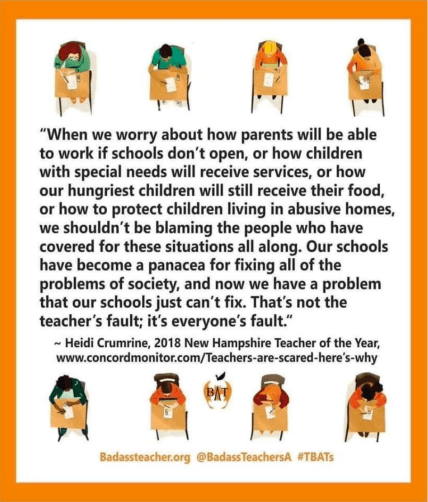
This quote (above) by Heidi Crumrine speaks to what my aching heart feels…“Our schools have become a panacea for fixing all of the problems of society, and now we have a problem that our schools just can’t fix.” And yet SCHOOLS NEED TO OPEN has become a rallying cry for those aching for normalcy and for a society that has expected schools to:

  • furnish daycare
  • feed hungry children
  • offer mental health services
  • provide dental and medical care
  • arrange for crisis intervention
  • protect children from abusive homes/situations
  • offer sports, arts, and extra-curricular activities (during and after school)

because we as a society haven’t figured out that our children (future citizens) would be much better off if the “village” rolled up its sleeves and offered these services as well. Asking schools and teachers to bear the burden while raising test scores, providing differentiated learning from severely disabled through highly ‘gifted’ span of learners, and meeting every state mandate passed by legislators has always been a big ask (oh, and please cut your budget by 5-10% each year–don’t want to raise our taxes, ya know!)

If we were the problem solvers and innovators that I always hoped America would be, we’d take this crisis as an opportunity to re-prioritize and creatively respond to the needs of our society rather than shifting responsibility (I.e. BLAME) to our schools.

Are we that America? As some schools that have reopened are already shutting back down again  we may have to seriously contemplate that question this year.  Does our village (America) really care enough  to raise our children?

Another Good Read…
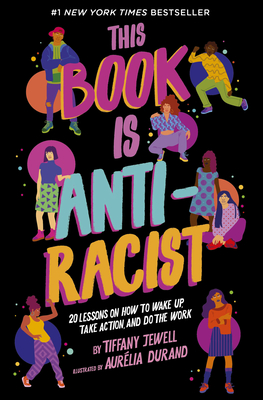
THIS BOOK IS ANTI-RACIST by Tiffany Jewel
Broken into 20 engaging lessons to empower young people, Tiffany Jewell guides readers through exercises to explore identity, recognize racism, fight its injustice, and become anti-racist. She shares stories of her personal history as well as cultural history that she quotes James Baldwin as saying, “We carry our history with us. We are our history.” If you ever wanted to build skill in speaking up, standing up, and becoming an anti-racist, this is the book for you and your children/students. The illustrations/graphics by Aurélia Durand are bold and beautiful, and the invitation to start a notebook to explore our experiences, beliefs, and identities really appeal to me. I think 6th grade and up would learn so much-I know I did. A must-have for any anti-racist resource library.

If You Really Loved Me, You Would

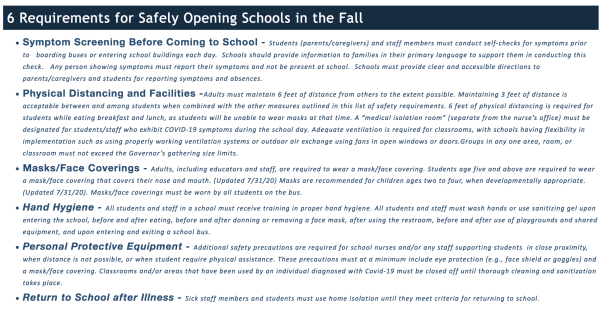
I live in Maine, and on Friday our state released the color coding system for reopening schools: Red means schools should only conduct remote learning. Yellow means schools should adopt a hybrid method of in-person and remote learning. Green means schools may return to in-person learning if specific guidelines set by the state can be implemented. Somehow ALL counties were classified Green! 

Our district has already been planning for a hybrid method and I think a lot of people were stunned that we were given a greenlight, but those specific guidelines that must be met will make in-person learning unrecognizable to most students, teachers, and families:

Screen Shot 2020-08-02 at 8.20.45 AM

Yet:

  • Our classrooms were built to the smallest size allowed by law.
  • We have 1 bathroom/sink in most rooms.
  • We have kids dropped off visibly sick at school each day.
  • We have a severe sub shortage to cover sick teachers’ classrooms every-single-day (pre-COVID).
  • We have parents who are anti-maskers and many students who are not compliant with classroom rules.

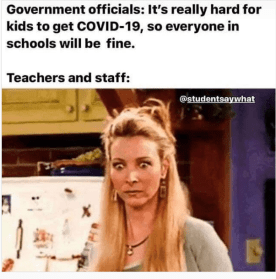
meme1In “normal times” these were challenges for teachers. During a pandemic they could be life-threatening.
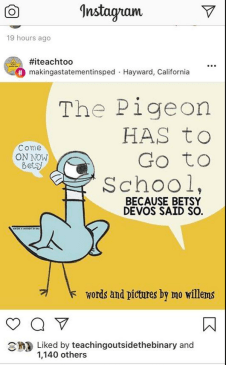
For years teachers have felt the pressure to take on more and more responsibilities for raising our nation’s children. Because we love them, we willingly and passionately do it. We spend our own money, our own time, our own emotional and physical health sometimes to care for these kiddos.

For awhile this spring we actually felt valued by society as it became glaringly apparent how much schools and teachers do for the children of this country every single day when we were suddenly cut off from them. Parents, politicians, and the public were praising teachers…for awhile.

But the pandemic rages on, and public opinion is shifting. Memories are fading. Gratitude is fleeting. From one of the biggest voices on down we hear cries of,

“Schools need to open.”  “Kids need to be in school.”  “If schools don’t open, we defund them.” “That’s their job, they need to do it.

And while I agree in normal times that that is the normal thing to do, we are NOT in Screen Shot 2020-08-02 at 10.22.34 AMnormal times. Teachers are retiring and resigning. Teachers are scrambling to get their affairs in order, to strip classrooms, and to prepare for the scariest days of their careers ahead of them.
We know kids need to be in school, but do people realize that schools will not be what kids have known. It is not hyperbole to say they will resemble correctional institutions with the restrictions and protocols being implemented. Emphasis on isolating, distancing, and safety precautions will take priority. All the engaging learning techniques we implement to connect with and reach our students are no longer appropriate or safe.

I’m wondering, how will…

  • 5 year olds who can’t keep shoes on and constantly chew their clothes be wearing masks all day?
  • primary students who crave reassuring hugs stay 6 feet away?
  • students sit in desks, in rows, with no personal items all day long?
  • dysregulated students respond to even more rules and regulations?
  • schools find substitutes willing to expose themselves to dozens of potentially deadly virus carriers each day?
  • teachers know if they are safe, or if they are bringing COVID home along with their lessons plans and piles of grading?

And yet the pressure is on to move forward. The implication: If you really love your students, you’ll just do it.

And my heart breaks because there is no good solution and we really do love our students…

Another Good Read…

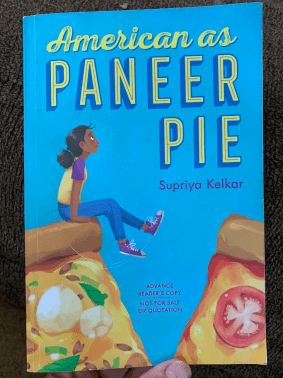
Screen Shot 2020-08-02 at 10.35.22 AMAMERICAN AS PANEER PIE by Suprikya Kelkar
I dare you to read this book without your mouth watering at all of the delicious Indian food being described! I also dare your heart not to melt a bit at the vulnerability and angst felt by 11 year old Lehka, born in Michigan of immigrant parents, who seems to live two lives: a home life filled with tradition and a school life where she is teased for her culture. Then a new neighbor moves in, Avantika and her family, who are new immigrants from India. Lehka worries that Avantika will be a victim of the xenophobia in her community, but is amazed at how Avantika isn’t afraid to stick up for herself. There are overt racist issues (hate crimes and the election of a xenophobic far-right senator) but there are a myriad of micro-aggressions that the girls endure as well, even from ‘nice people’. Even Lehka and Avantika realize their need to work on their own issues with colorism, tolerance, and how to be an ally. Slowly Lehka finds her own voice and realizes our society’s problems aren’t going away quickly, but that we can still make a positive impact one person at a time. I would have loved a glossary to help me with unfamiliar terms and language, but Kelkar does a pretty good job of using context to help the reader along. Another wonderful selection for #WeNeedDiverseBooks in our classrooms to promote understanding, tolerance, and appreciation for all people and to expand our definitions of being American.