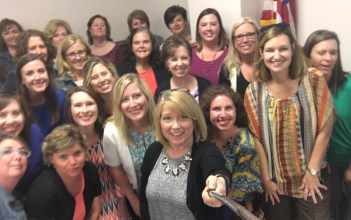
 Two colleagues (Melissa Guerrette, Susan Dee) and I were asked to be Twitter Ambassadors for this past weekend’s New England Reading Association annual conference. The NERA conference was held in Portland, Maine so it was right on our home turf! Now I had never heard of a Twitter Ambassador, but I was intrigued. I found out that basically it was our task to support NERA members in becoming more active on social media and to generate some buzz about the conference.
So we:
- Had a Twitter Central kiosk with information on getting started and who to follow
- Created a photo frame to memorialize attendees conference presence on Twitter
- Had a streaming display of conference tweets on Visible Tweets
- Tweeted out from every session we attended
- Tweeted photos of attendees, vendors, and presenters
- (At one point we were trending and therefore had the inevitable attack of raunch that we had to monitor and block!)
I thought rather than discuss all the amazing sessions and experiences here, I’d share my Storify of tweets here. Storify is a great way to memorialize stories or timelines of events that you could share with others. If you haven’t tried it, check it out HERE.
My #NERA2016 Storify
I also LOVE collecting and sharing photos via Google photos, so I’ll share some of those here as well!
Google Photos #NERA2016
How can you find ways to capture, memorialize, or reflect on your professional experiences? There are a lot of tools that can help make that task easier. You might want to take some time during your upcoming summer break to check some out!
What’s On My Book Radar?
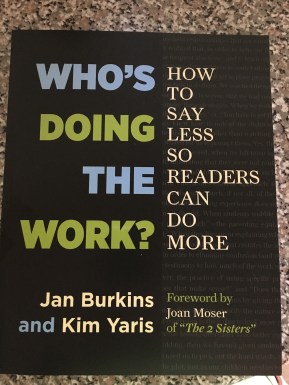
YES!!!
This book! I am just getting into it, but I already have to recommend it. The whole premise of Jan Burkins’ and Kim Yaris’ book aligns with one of my most repeated coaching comments,
“Whoever does the work, does the learning!”
Jan and Kim look at some of the more traditional practices that were attempts to scaffold children, but that may inadvertently rob students of opportunities to become more self-directed learners. They suggest adjustments to instruction that hold students accountable for their own learning.
You can follow the conversation about this book on Twitter at #whosdoingthe work
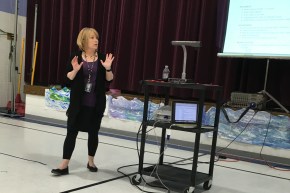 Our teachers look closely at students’ writing all the time and three times a year we do so together as a district. We give three benchmark, on-demand, prompts as formative assessments to evaluate the strengths and needs of our young writers. This past week our K-6 teachers got together for an early release workshop to analyze some of that writing. Most of the time they simply score their own students’ work with our writing continuum and share what they notice with their students. On this day they had an opportunity to share with their colleagues as well.
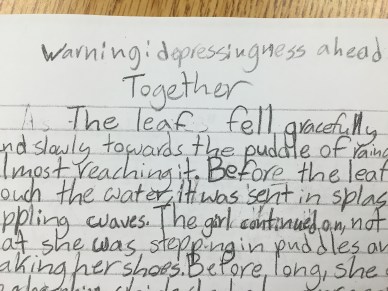 We scored some together, pulled new anchor papers, revised our assessment tool, and charted patterns of strengths and needs. But the best part of the day was hearing teachers say over and over, “Wait, you’ve got to read this one!” There were stories that made us giggle, weep, and drop our jaws! More than once I heard someone declare, “I wish I could write like that!” The room was filled with teachers enjoying the writing of their students. Now that’s not to say that every student “exceeded the standard” or that we are nurturing a giant crop of Hemingways. Sure there were some stories that left us scratching our heads and moaning slightly. But teachers still observed growth with most of these writers and developed ideas/plans with their colleagues for supporting them.
 The social media was exploding with memes of support and appreciation for teachers. Most were quite humorous. Many had me giggling but were sadly true. While it is great to have a week of acknowledgment and appreciation, it would be far better to have policies and public discourse that backed up those sentiments with action that supported our schools every day. Those parents who spoiled us with kindness this week get that. They are the ones who care year round because they see firsthand the dedication of teachers and staff who work with their children. I understand it is harder for those who aren’t regularly in schools to have a similar level of appreciation. But there are some things they could do.
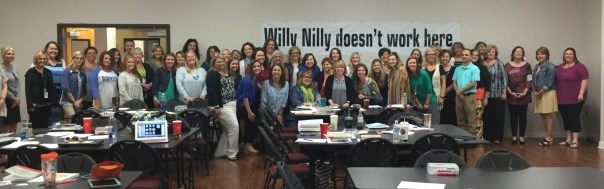 One of the best parts of my job as a literacy coach (in five buildings) is that I get to visit a LOT of classrooms. This allows me to see the wide-ranging variety of environments, approaches, and lessons that teachers create to meet the needs of our learners. I can see firsthand that there is no “one right way” to teach. I am inspired by new ideas and strategies that I observe, and I do my best to share those with other teachers. Sometimes I feel like a honeybee who flits from flower to flower picking up and depositing the pollen of pedagogy. It’s one of the aspects of my job that I love the most!
 were eager to share the work going on in the hundreds of classrooms in their district. We discussed the progress they have made and their vision for moving forward. Teachers brought student writing from their state/local assessments. As I shared my ideas with teachers that day, I was able to contemplate the similarities and differences of our journeys. It gave me an even wider perspective on the needs of young writers and for their teachers who constantly strive to meet those needs. Teachers asked questions and shared ideas that helped me to grow as well.
 reinforced my insistence that teachers be allowed opportunities to visit other classrooms to observe the myriad of possibilities for teaching approaches. Far too often teaching can be an isolating experience. Spending day after day ‘alone’ in our classrooms can limit our expectations or distort our perceptions of possibilities. Schools need to foster a greater sense of community within our buildings, but also beyond. We can learn so much from others who hoe this same row each day.
 Tributes and memorials are flooding social media as people want to share memories that reflect how his music was meaningful to them, personally. His passing left many remembering moments when his music was the soundtrack of their own lives. So many words of adulation are filling up that empty space he once occupied.
 about the room… Kind. Dedicated. Amazing. Committed. Sweet. Strong. Determined. These were mostly from the teachers who worked with Jane. I’m sure there would be others from her husband, daughter, mother, and childhood friends. Memory pages were being passed around in which we were invited to share some remembrance. How do I choose 1 memory to represent years of friendship and collegiality? How can I adequately pay tribute to this beautiful, courageous, and gentle soul?
 After I read Salt to the Sea (by Sepetys) I found out she had written this book previously that is a companion (not prequel) and I had to read it. This book tells the story of 15 year old Lina (Joana’s cousin) who is preparing for art school when the Soviet secret police barge into her house one night and deport Lina and her brother and mother to Sib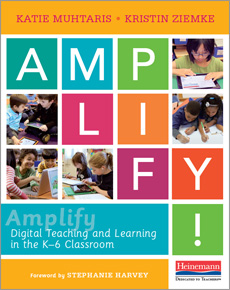
 I have been waiting so long for this book! When I met Kate DiCamillo last fall at NCTE I was captivated by her. I’ve always loved her writing, and you can see how naturally it springs from her ability to talk and tell a story.
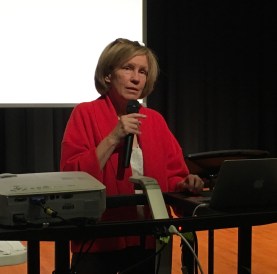 written work. Yesterday I was blessed with the opportunity to practically sit in the lap of a favorite giant. Lucy Calkins was the keynote at this year’s Write Now Conference in North Conway, NH. Every year Penny Kittle brings some of the greatest giants to her high school for this conference honoring the legacy of Donald Graves. It seems only fitting that one of Graves’ most prolific proteges be a part of this event.
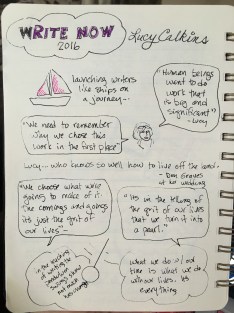 about the young writers she has mentored. She encouraged us to do the same. I can’t begin to choose which words to share, so I’ll share the sketchnotes I captured and let you decide what resonates with you.


 litcoachlady