FIND KIND

When given the choice between being right or being kind, choose kind.”-Wayne Dyer

For anyone who read the brilliant novel Wonder by R.J. Palacio, this precept is very familiar. It is one of my very favorite (of many) that Auggie’s teacher, Mr. Browne, shared with his students. Choosing kindness is just that, a choice, but it is also a principal to live by. After enough practice it becomes a habit, and habits become so ingrained that we sometimes don’t even notice.

But we do not need to wait for a situation to arise in which we are given the choice between being right or kind, we can live our life in search of opportunities to “Find Kind”. We can look for instances in which our acts of kindness would lift another person, benefit our community, or build the type of world in which we want to live.

To Find Kind, we just need to have empathy and an awareness of the struggles and challenges that those around us face.

I saw an amazing example of this precept this week. Some of us teachers were posting on Facebook about our frustration that an amazing education conference/retreat was taking place right here in our state (Maine) this summer and that the cost made it too prohibitive for any of us to attend. We were vexed by the notion of being ‘so close and yet so far’. Someone noticed that conversation and took it as an opportunity to FIND KIND!

Cynthia Lord, Maine author of Rules, Touch Blue, Half a Chance, and the Hot Rod Hamster series empathized with the frustration expressed, but moved beyond empathy to action. She responded in her own Facebook post that in part read,

I was sorry to read that some of my teacher friends would love to go to this event right in our own backyard, but it’s out of reach.

Another thing that I know about Maine is that people help each other. As a writer, I’ve been very fortunate this year. I just sold two more early readers and I figure what better way to celebrate that than to celebrate my state’s teachers who actually teach reading and writing.

This year, my family can afford this. So my husband and I want to send one of you to this amazing conference.”

From her own hard-earned money, Cynthia chose a teacher at random (from those who responded to her post) and paid for the registration and lodging for this teacher. All Cynthia asked was that this teacher share what she learned with the other teachers who also wanted to go.  Cynthia asked her to meet either online,  at a coffee shop, or in some other way to spread some of her new knowledge and learning. In that way, even more teachers and students would benefit from this act of kindness.

Needless to say, all of us were overwhelmed with Cynthia’s generosity and altruism. She went out of her way to find a way to show kindness to a group of teachers. Her husband, equally chose to be kind, to people he had never met. They weren’t asked for a donation or help…they created an opportunity for kindness. She did something as unexpected as it was generous to FIND KIND. Even those who weren’t ‘picked’ to attend the conference were changed by this act. I felt ‘lifted’ by knowing that I live in a state with such caring and compassionate people. The comments by others displayed genuine happiness for the teacher who was selected and not jealousy or resentment at missing out. I felt more hopeful and optimistic about people and life.

I didn’t write this post to encourage people to ask authors or celebrities or others to help them out. On the contrary, I wrote it to encourage people to find opportunities to offer kindness where it isn’t being solicited. To FIND KIND, you just need to notice, to observe, to listen, to care. To FIND KIND doesn’t require money either. Sure, money can help in a lot of ways, but so can a kind note, a home cooked meal, a ride to an appointment, a piece of chocolate! Random acts of kindness create ripples in our world. Many ripples can combine to create a wave.   Look around you, who do you know that could use a little ripple? Who do you know that is good at creating ripples? Your noticing and responding will help create a wave.

What will you do to contribute to a wave of kindness in your world?

How will you, FIND KIND?

What’s on my Book Radar?

Last month the Maine Student Book Award winners were chosen by students all across Maine.  Here are the top 10 and the number of votes they received.

1. Wonder                                 713
2. Cardboard                           433
3. The One and Only Ivan  365
4. One for the Murphys      308
5. The False Prince                233
6. Earthling!                            156
7. The Ghost of Graylock   139
8. Ungifted                               138
9. Capture the Flag               125
10. Island of Thieves            114

Students had to have read at least 3 of the nominated books in order to vote.  I was able to read 20 of the 40 titles.  There were 4 of the top 10 I missed, but rather than reveal them, I will quietly put them on my book radar and get them read by summer’s end. I’m happy to say I have a good start on next year’s nominees!!
MSBA Book Nominees 2014-2015

Welcome to My Reading Life

I wasn’t going to blog this week.  Whatever nasty virus that has been making the late winter circuit finally caught up with me.  I was out of school for two days, and my workload kept piling up.  It would  have taken something pretty special to inspire me to carve out some time for my blog this week.  That something special walked over to my desk yesterday afternoon.

At the end of the day, I was back at my desk in my glassed-in cubicle at school.  In walked one of the most timid 4th graders, looking a little nervous, as though she was afraid to bother me.

“Do you have a book recommendation?” she breathed.  So quiet was her voice I couldn’t quite make out the words.  “Do you have any book recommendations?” she repeated.  Now, I have met kids in hallways and classrooms all year long inquiring as to what they were reading and recommending books on the fly.  Kiley was the first to come to me and ask on her own.  I had several books in mind I knew she would love.  Cynthia Lord’s Half a Chance and Natalie Lloyd’s A Snicker of Magic were two of my recent favorites, that I was confident Kiley would dive right into.  Unfortunately neither were there at my desk, having been loaned out to others.

I asked Kiley if she’d like to read one of my new books that I hadn’t yet read and then tell me her review of the book.  I had a signed copy of The Waffler by Gail Donovan.  I told her that it was just announced as a nominee on the list for next  year’s MSBAs  (Maine Student Book Award) We read the book jacket together and she eagerly nodded her head notifying me that she’d like to try it. As she left, I found myself smiling.  I felt honored that she thought I  knew her well enough as a reader to recommend a book that she’d enjoy.

Well, that good feeling got even better today when Kiley walked over to my room after lunch   “I’ve got a book recommendation for you.”  she beamed.  From behind her back she pulled out a paper back and handed it to me.  “My mom got me this at the book fair.”  I looked down at a copy of The Power of Poppy Pendle by Natasha Lowe.  She looked so happy as I flipped through the book.

“Have you already read all of this?” I asked her.

“Mmm hmmm.  I read it as soon as I got it.”

“So you think I’ll like this one?”  Nod.  “Then I definitely have to read this.”  I asked her if I could keep it for the weekend  since I didn’t think I could finish it in one night.

“Yeah, sure!”  she smiled at me.    I thanked her profusely as she headed back to class. “Oh, and I’m half way through The Waffler.   It’s good!”

Now my pile of must-reads, gotta-reads, need-to-reads,  should-reads and wanna-reads is massive, but  you can bet I am carving time out of my weekend to read The Power of Poppy Pendle.  Not because I can’t wait to see the power Poppy is imbued with, but because of the power steeped in that gesture by Kiley and my eagerness to talk with her about it next week.

She saw reading as a way to connect with others. She recognized that reading experiences can be shared.  She had confidence in herself as a reader to make recommendations to others-even teachers.  She welcomed me into her reading life  and she knew she was welcome in mine.

That kind of medicine got me feeling pretty good again!

Teacher of Writing or Writing Teacher?


I had the good fortune to participate in a fantastic #engchat on Twitter this week. How We Write: Learning from the Process of Writing with Kelly Gallagher and  Penny Kittle,   Joining in were Meeno Rami, Georgia Heard and countless other educators with thought provoking tweets.  What made this chat so meaningful was that it wasn’t just about student writing, but encompassed teacher writing as well.  It really got me thinking about teachers and writers in a more profound way.

“You can’t call yourself a writing teacher if you are not writing yourself. “-Donald Graves

Occasionally I run into teachers who claim “I’m not much of a reader.”  Luckily that is a pretty rare occurrence.  In fact, the teachers in our district (Augusta, Maine) even have a 25 Book Challenge club going for the second half of the school year.  We have conversations about books we love (or hate) and recommend books to one another based upon our knowledge of teachers preferences as readers. We created a Facebook page to stay linked and up to date with our progress. It has created a community around reading.  We feel connected to other readers, we can appreciate what reading means in our lives and we share that passion with our students.

Now shift the conversation to writing…the declaration “I’m not much of a writer.” is something I hear teachers say all the time.  Maybe we need to look more closely at why this is so prevalent. More importantly, I believe,  we need to examine the question, “Does it matter?”   Does our lack of confidence in our own writing influence our approach writing instruction?  Does it shape how we respond and coach students to grow in their own writing?  Does the perception of our own abilities reflect in the perception of our students’ abilities?  How could it not?  Our reality is shaped by the prism of experience and beliefs through which we see our world.

When we are writers we can empathize with the act of putting our thoughts, ideas, and words on paper and waiting for a reader to judge their quality.  We can experience the vulnerability of receiving feedback that may be less than beaming praise.  We can understand how sometimes the ideas don’t flow, the right words don’t come, or the moments don’t explode the way we want them to.

When we are writers we can appreciate how much stamina it takes to stick with a piece you are sick of rereading.  We can see how someone’s’ “suggestion” just sounds like criticism.  We can see that coming up with ideas isn’t as simple as making a list of things we like.

When we are writers with our students we can make that mysterious process more visible.  We can show our students that not everything that is written is good (yet)! We can show students the moves a writer makes; the countless decisions that are made on the fly in the creation of even a single sentence.  We can show them the intention that is present in word choices, line breaks, sentence length, punctuation, repetitions, alliteration, figurative language, etc.  We can show them how WE struggle, how all writers struggle from time to time. We can help to build GRIT into the writing process.

When we are writers we can appreciate the joy that comes from completing a strong piece of writing.  We can understand what it feels like to hear people laugh at the parts that are supposed to be funny or cringe at the parts that are supposed to be creepy.  When we are writers we can experience the feeling of satisfaction when our revised pieces really  do look and sound better after our efforts.  When we are writers with our students we can celebrate those successes together.

When we are writers we can help our students to trust the process, to trust us. We can provide instruction and not just instructions.  When we do the same writing assignment we ask of our students, we can better see where those scaffolds might need to be created, what parts might be trickiest, where more patience might be required. When we take risks in front of them, they may have more faith that we really do honor risk taking.   Our credibility as a writing teacher takes on a whole new meaning.  We build stronger relationships with our students that go beyond the writing lesson.

If we aren’t writers ourselves how can we do this? Do you believe what Donald Graves said? “You can’t call yourself a writing teacher if you are not writing yourself.”

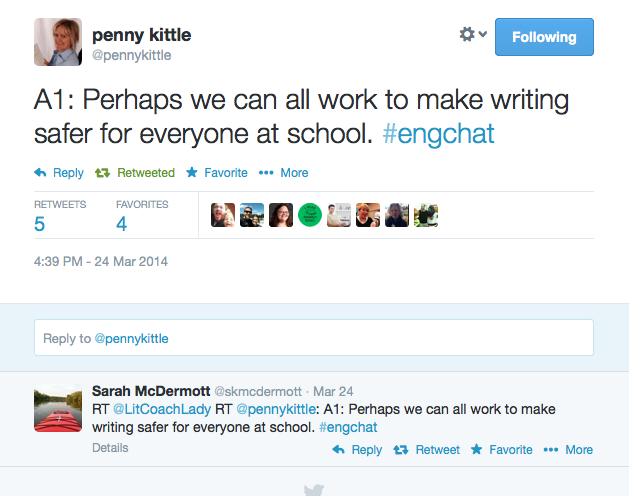
One tweet from Penny Kittle provoked some thinking about the environment in our schools around writing.

https://twitter.com/pennykittle/status/448242773401935872

So how CAN we work to make writing safer for everyone at school? How can we encourage teachers of writing to become writing teachers? How do we create a climate that supports writing and risk taking?  I’m sure there is no one right way, but I am sure it will require someone to be the impetus.  Someone will need to ask the question, “Do you think writing teachers should be writers?”  Someone will need to reach out to teachers to start the conversation.  Someone will need to take the lead in sharing their writing life with others. Someone will need to listen to their concerns and anxieties.  Someone will need to suggest some ideas.  Will you be that someone?

If you are interested in learning about what some other teachers are doing you could check out:

The 100 Words for 100 Days #engchat Challenge

TeachersWrite! with a new date  for 2014 from Kate Messner

The National Writing Project (NWP)

Edutopia Blog

The Atlantic

I’d love to hear how you are supporting writing in your schools and making it a safer place for writing to thrive.  Leave a comment or  find me LitCoachLady on Twitter.

What’s On My Book Radar

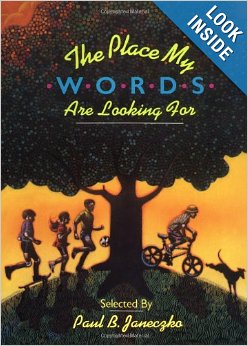
51hmVecabsL._SY344_PJlook-inside-v2,TopRight,1,0_SH20_BO1,204,203,200_The Place My Words Are Looking For is not new, but when Georgia Heard recommended it during the #engchat I knew I had to get my hands on it.  If you have ever wanted some insight into what poets thought process, inspiration or method for writing might look like, you need to check out this book.  39 poets share poems and their process.  What a great book to tie into the theme of teachers as writers.  We can learn so much from these authors as they teach us about writing and allow us a peek into their literate minds.

HAPPY READING (and WRITING!)

Got Grit?

If you aren’t familiar with the term Grit, you might want to look up so you don’t get run over by the bandwagon!  Seems the phrase and the topic pops up quite frequently of late.  Ironically I started writing this post and then tuned in to hear NPR run a segment this morning Does Teaching Kids To Get ‘Gritty’ Help Them Get Ahead? and another this afternoon On The Syllabus: Lessons In Grit.  I highly recommend giving them a listen.

Angela Duckworth is a psychology professor at the University of PennsylvTrue_Gritania who coined the term “grit” (yes, based upon the novel and/or movie True Grit)  She received the MacArthur “genius grant” for it in the fall of  2013. According to Duckworth, “Grit is passion and perseverance for very long-term goals. Grit is having stamina. Grit is sticking with your future, day in, day out, not just for the week, not just for the month, but for years, and working really hard to make that future a reality. Grit is living life like it’s a marathon, not a sprint.“-Angela Duckworth TED Talks April 2013

The concept of Grit goes hand in hand with Mindset, in particular with a  Growth Mindset.  People with a growth mindset believe brains and/or talent are a starting point, not the only point.  They believe that with passion, practice and perseverance (Grit!) goals can be achieved and talents can be developed.  With a Growth Mindset (and Grit) students can learn from struggles and even failure more successfully.  They embrace the notion that FAIL = First Attempt in Learning and the word yet follows most “I can’t” statements.

The work of researchers and educators at this point is to see whether Grit or even Mindset can be taught to students in schools.  I think over the next few years we will see some compelling studies and some supports for schools interested in fostering these traits with their students. Certainly the work of Carol Dweck and her Brainology program is gaining traction in many schools.

But focusing on students alone is not where my thinking has coalesced on the topic, what about the teachers? If a profession ever needed Grit, teaching would surely be one.  There are struggles and failures on a daily basis when one is tasked with the education of dozens of very distinct and unique individuals.  There are parents with whom we need to communicate, administrators we need to please, curricula we need to master and a public that often views us as social welfare recipients.  Teachers (especially elementary) are often expected to be experts at everything!  Talk about a recipe for failure some days!

I work with new teachers every year and often wonder who will not only make it, but who will thrive and excel.  I work with veteran teachers who have been presented with ever changing reforms, initiatives, standards and evaluation systems.  I marvel at those who face every challenge with tenacity and a positive attitude and I look for ways to support those who are frustrated and exhausted.  Most of us lie somewhere in the middle of this spectrum.

mindset-sphere-hi-res-original-d-rendered-computer-generated-artwork-31936958-1Maybe one way to build our Grit and that of our colleagues is to first be aware of our Mindset and our level of Grit.  Understanding how we approach challenge and/or failure could be a first step in learning new strategies for dealing with  them and help us shift our thinking more successfully.   You can check out the  GRIT SCALES here.

Another way might be to cultivate a climate of Growth Mindset with our colleagues.  We can celebrate and be inspired by the success of others without feeling threatened or judgmental. We can seek out and learn from feedback without seeing it as a criticism of ourselves as people, but rather as a tool for stretching our abilities and understandings. We can recognize and acknowledge effort.  The teacher who always lucks out with the “good class” isn’t just lucky.   We can examine what it is that she/he does to create those conditions year after year.  We can embrace challenge and spend less time resisting the inevitable changes that come each year.  Lean on one another, problem solve together, encourage, praise and coach each other.

We can model Grit for our students.  Let them see us struggle with something and not give up.  Show them how we work through problems.  Don’t be afraid to make mistakes.  Show them what stamina looks like in ‘the real world’.  Help them set long term goals and not just seek instant gratification.  Let them feel some discomfort in grappling with new and unknown and resist the urge to jump in too quickly.  Let there be silence as students endeavor to comprehend ideas, formulate thoughts and solve problems. Teach them the power of the word, YET by using it often.

I think we can all agree that success comes from talent, hard work, perseverance, and passion (and occasionally some luck).  How we help our students and ourselves achieve success will depend upon the grit we display as we grow and learn.  The mindset we espouse may very well determine how ‘true’ our grit really is.

Share your own ideas for teaching grit. 

I welcome your feedback as an opportunity to continue to grow and learn!

What’s On My Book Radar?

51gNghE+NvL._SY344_PJlook-inside-v2,TopRight,1,0_SH20_BO1,204,203,200_I finally got my hands on Natalie Lloyd’s Snicker of Magic.  I couldn’t wait to read the book I have been hearing so much about and I must say it has been worth the wait.  In fact, I have not yet finished reading it, I am totally savoring this one.  Felicity Pickle is a 12 year old girl who can see words as an aura around people and objects.  I am fascinated by the entire cast of characters who live and pass through Midnight Gulch, the town with just a ‘snicker of magic’ left in it.  Layered with compelling back stories of the history of the town and Felicity’s own family- this story is woven with a special magic from the first page! This will be one of those rare books I don’t want to leave, so I am in no hurry to finish. Oddly, I’m finding my ice cream craving has returned as well!!

Celebrate Reading

It’s a great week for lovers of reading!  Sure, every week is a good week for reading, but two major events this week give us plenty of opportunities to celebrate books and readers!  I think these celebrations are important for building a community of readers, for modeling reading for pleasure, and associating joy with the act of reading.

READ ACROSS AMERICASeuss1

Although typically celebrated on March 2nd to coincide with the birthday of Dr. Seuss, this year we celebrated on Monday, March 3rd.  Teachers gathered every book they could find penned by Theodore Seuss Geisel.  Some found fun facts about the man (including the REAL pronunciation of his name).  Some had extra DEAR time or Read to Self.

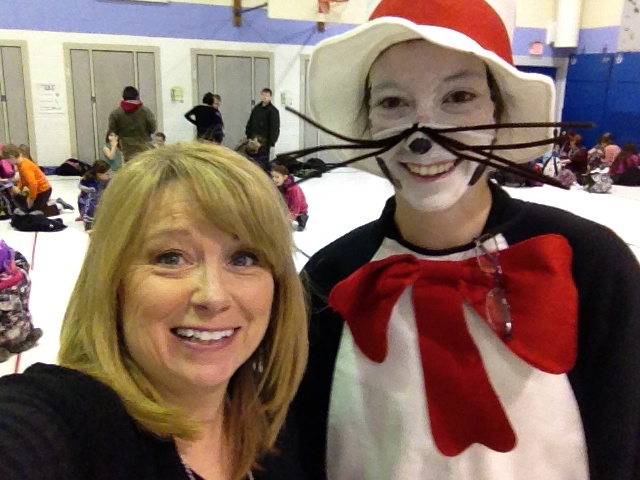
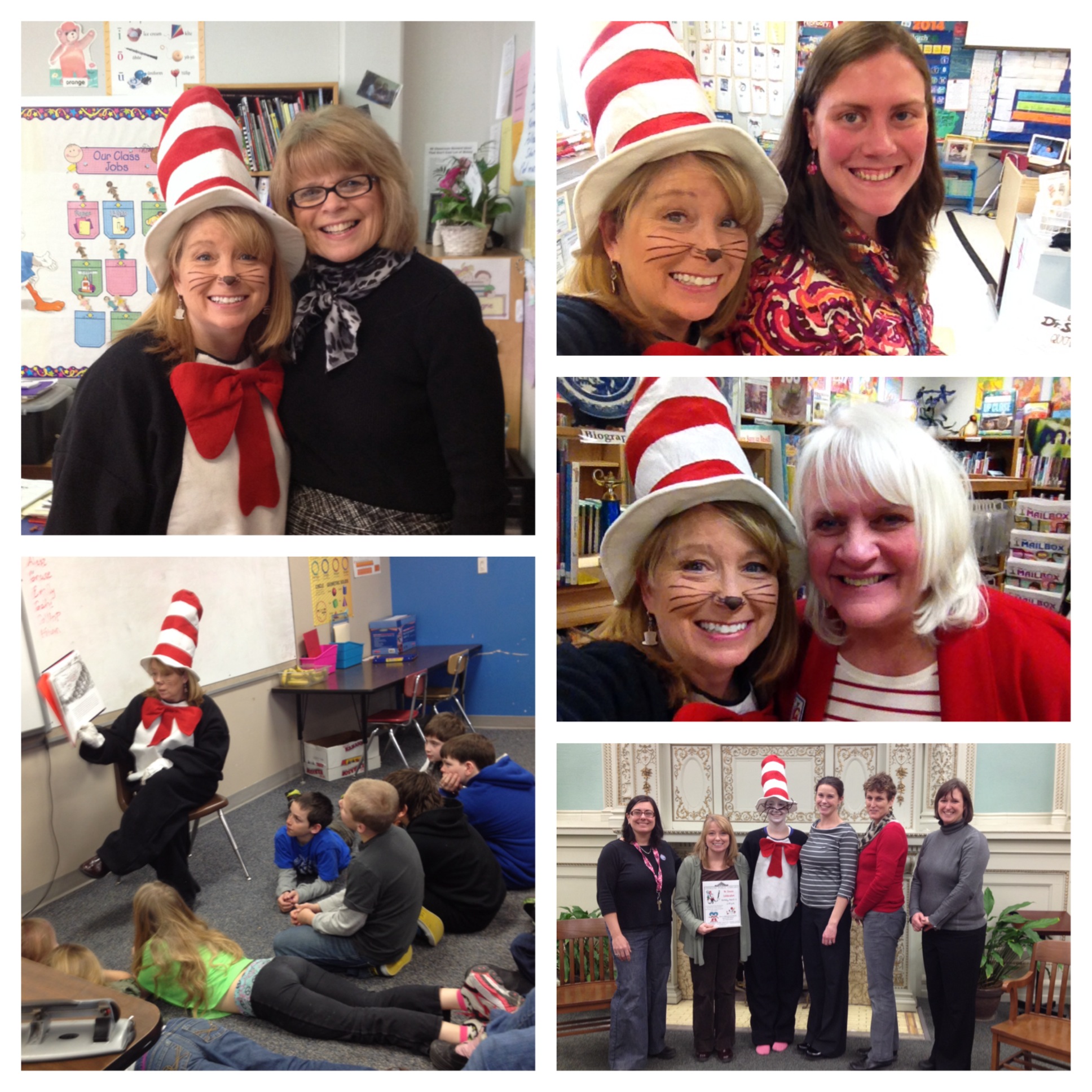
I really got into it this year.  My inspiration came from a group of teachers in my district who wanted our local education association (a.k.a. ‘evil teacher union’ to some) to do more outreach for children and community.  We took on Read Across America as one of our causes.  We collaborated with our local library (Lithgow Library) to creaIMG_5780te a Read Across America Night for families. One of our newest teachers, Ms. Bryant, contacted our state association to acquire our Cat in the Hat costume.  During the day I visited 3 of our elementary schools as the Cat and  Ms. Bryant assumed the feline role for her home school and the library celebration.

It quickly became one of my favorite days ever as a teacher.  Some kids looked at me with such cognitive dissonance. There was a hint of recognition, yet they approached me anyway with excitement and affection.  Others were just so joyful and eager to pet, hug and tug on the Cat!  I read in classrooms, listened to kids read, took lots of group photos of eager readers and happily dissolved into the persona of Le Chat Au Chapeau!

IMG_5909

My day as “The Cat”.

IMG_5921

Our evening Dr. Seuss Celebration in collaboration with our local library.

         WORLD READ ALOUD DAY

Screen Shot 2014-02-27 at 7.06.11 AMThere’s still time to continue the reading celebration this week. March 5th  is World Read Aloud Day. It’s a grassroots movement that LitWorld started to with the idea that “Children who grow up as readers become engaged citizens of the global world, and every child deserves that right to read.”  You can read founder Pam Allyn’s blog on HuffPost here.

You can visit Lit World’s World Read Aloud Day page.

Here are some World Read Aloud Day Activities.

Here are some Read, Write Think Activities and Resources.

But the best thing about reading is that you don’t need a holiday to do it.  You only need a book.  You need a teacher, parent or mentor to help you make sense of those squiggles on a page so that the ideas lift off the paper and create stories in your mind.  These holidays and events just remind us that every child has that right and it is up to us to help them realize all the possibilities in life that reading can offer them!

What’s on my book radar?

61U8xnLYSRL._SY344_PJlook-inside-v2,TopRight,1,0_SH20_BO1,204,203,200_Better Nate Than Ever by Tim Federle

This book is as hilarious as it is touching.  Nate Foster has wanted to be in a Broadway musical his whole life (all dozen or so years of it.) He takes a runaway road trip from his hometown in Pennsylvania to audition for “E.T. The Musical” He doesn’t really fit in in his hometown of Jankburg, PA.  His brother is an all star jock, Nate is bullied and school and describ51MG+Y1aguL._SY344_PJlook-inside-v2,TopRight,1,0_SH20_BO1,204,203,200_es himself as “a freshman at the College of Sexuality and I have undecided my major”.   It’s great to see books about boys who aren’t just jocks or thugs or bookworms.  Nate is a refreshingly humorous, sensitive and daring boy who recognizes his differences and embraces them.

Now I need to get my hands on…

Five, Six, Seven, Nate! by Tim Federle

You can watch Tim Federle read from Better Nate Than Ever here!

PROFESSIONAL BOOKS:  How’s It Going?

books

So excited that I will see Carl Anderson in Portsmouth, NH tomorrow with his Heinemann Workshop.   I’ve participated in a book study in our district with How’s It Going.  If you haven’t read this one and you want to improve your practice with writing conferences, it is a MUST READ for your professional library!   He isn’t called “Conferring Carl” for nothing!!

HAPPY READING!

Trajectory

I recently read an article about the influence of trajectory on our perceptions of events.  The gist of the article deduced that if an event was not very satisfying but ended very positively (upward trajectory) that the event was perceived as an overall positive experience.  To the contrary, if an event seemed successful but ended rather negatively (downward trajectory) that event was often perceived as an overall negative experience.  In addition, that perception shapes future experiences.

I have witnessed this phenomenon in classrooms that have had a productive and engaging day only to end with a chaotic dismissal that leaves the teacher exhausted and disappointed.  Teachers have confided, “It was going so well and then they lose it.”  The teacher feels somewhat defeated and down about the day.

In other instances an activity starts out with high engagement and ends with students rowdy, off task or disengaged.  The really positive experience of the activity is overshadowed by the ending frustration.  Student learning is compromised and teacher patience or confidence is worn down.

These observations have led me to contemplate the effect that trajectory plays on instruction and practice in classroom. Coaching teachers to visualize how they want their day to end or how they will monitor student work to know when to wrap up a lesson has helped to create more positive trajectories in some instances.  I created a menu of ‘end of day’ routines that teachers and I collected to share with colleagues and a student checklist to encourage them to become more self-regulated in their behavior at the end of the day.  I’ve asked teachers to consider planning for students who finish early or who haven’t yet finished, since rarely will all students complete tasks simultaneously.  This has helped them create ‘contingency’ plans or convey expectations to students that have helped lessons end more positively.  Rather than being the victim of circumstance, they actively shape the trajectory of the event.

I’ve not only shared my thinking about trajectory to help them in their classroom routines and instruction, but I’ve tried to include it in the work I do with teachers as well.  At recent grade level meetings I knew we would be engaged in a lot of intense work looking at standards and our current curriculum, so I wanted to make sure our meetings ended with a positive trajectory.  The last 15 minutes I encouraged teachers to share a joy they have had in their classrooms this year.  Providing an opportunity to celebrate some of the better moments and experiences with colleagues.  Ending collaborative and rigorous work on a positive trajectory leaves a satisfying ‘taste in the mouth’ of those involved, reminding us of the reasons and rewards of teaching.

My coaching protocol had generally begun with some positive validation before offering teachers a ‘lift’ or support.  I still find this to be very productive, but I now try to make sure coaching sessions or conversations end on a positive trajectory as well.  I’ve never seen my role as “fixing” teachers but I’m even more determined to respond to all the wonderful work they do, to help them recognize it and replicate it continually.  Teachers rarely need help analyzing ‘what went wrong’-we are notoriously hard on ourselves.  But rarely do we take time to analyze ‘what went right’ so that we can use that knowledge to create more success.  As a coach, I am in a unique opportunity to support them with this analysis and reflection.  A coaching session should leave teachers feeling validated, energized and more confident.

So if you thought about the idea of trajectory in your schools or classrooms, how might that affect your practice, conversations or collaborations?  It might be an interesting conversation to have.

What’s on My Book Radar?

Today is the book birthday of Cynthia Lord‘s latest work Half a Chance.  Set in New Hampshire, and involving one of my favorite passions (photography), Cynthia again creates characters that draw you in with their struggles that kids can relate to.  I can’t wait to see how Lucy adjusts to her new home, finds new friends and earns the respect of her very talented father.

9780545035330_p0_v2_s260x420

I just finished Escape From Mr. Lemoncello’s Library by Chris Grabenstein. If you loved Charlie and the Chocolate Factory and you love a good puzzle, this book will soon be one of your favorites!

lemoncellos-library-300h

watch the trailer!

HAPPY READING!

Book Giving Day

Here in Maine we are approaching our February break.  In this week alone we have the 100th day of school, Valentine’s Day, a half day workshop (and a threatening snow day).  Teachers are trying to pack in so much before the students are away for a week’s vacation.  So I was reluctant to introduce one more ‘thing’ into their busy lives.  It would have to be something pretty important, pretty special.

Well, this one is a ‘no-brainer’.  Getting books into the hands of readers?  Pretty important and pretty special. images This Friday, February 14th (aside from being Valentine’s Day) is International Book Giving Day! This is a day dedicated to getting new, used and borrowed books in the hands of as many children as possible.

The International Book Giving Day site lists 3 ways to “celebrate” this festive day:

1. Give a new, used, or borrowed book to a friend, relative or child.

2. Leave a book in a waiting room or lobby (where kids might be hanging out and would pick up a good book).

3. Donate books that you or your children have ‘outgrown’ to children or organizations that could really use a book or two.

Int-Book-Giving-DaySo you see it’s pretty simple.  Give a book. You can share your plan for giving at the website and add your name to the list of people giving books to kids!

They’ve got downloadable bookplates that you can share with others and print posters celebrating International Book Giving Day in a variety of languages!

Just because the event is listed as February 14th, doesn’t mean the giving can only last a day!  If you are too busy giving and receiving chocolates and roses this Friday, make this event a weekend or week-long celebration. I’d like to see International Book Giving WEEK take off!

You can follow this on twitter #giveabook  and @bookgivingday

 Share in the celebration, share the joy of reading, share a book!!

What’s on My Book Radar?

I just finished Megan Frazer Blakemore’s mysterious book The Water Castle.  Set in Maine, this story is a marvelous weaving of the past and present in which several generations of families in the town of Crystal Springs uncover secrets and make discoveries that will leave the readers wondering “Do you believe in the unbelievable?”

You don’t have to be from Maine to appreciate this book, but I recommend that every Maine kiddo get their hands on a copy!

HAPPY READING!!

“Whatcha readin’?”

As a literacy coach in four elementary school buildings, I interact with a LOT of students.  I try to greet every student that I meet in the hallways, libraries and cafeteria.  I try to remember their names, but there are hundreds and hundreds to keep straight.  They’ve been known to mangle my name as well (I often joke ‘Bourque rhymes with jerk, not dork!’)  Even if I cannot recall a name, these interactions are important-they are connections that tell the child… I notice you.  I care about you.

Recently I’ve tried a different exchange that has produced some differenOak+Brook+Barnes+and+Noble+2t results.  I still say good morning or good afternoon as we pass in the hallways, but I’ve added a new salutation…”Whatcha readin’?”  Kids who were ready to echo back a “Hi.” stop and look down at their book and then share the title.  Not only do most seem eager to tell me something about it,  but they almost always engage in a brief conversation that is much more personal than our traditional ‘hellos’.   They’ll share a brief summary, talk about titles of other books,  or ask me if I’ve read it.  If I have, I’ll share my thoughts. If I haven’t, I’ll ask them if they would recommend it.

Now when I see them in the hallway, many students initiate the conversation with, “Guess what I’m reading now?” or “Mrs. Bourque, here’s my new book.”  Our schools have recently started a 25 Book Challenge and so many more kids are in possession of books at any given time in the school day.  When I come into some classrooms I am met by students who want to tell me what they are reading or ask me if I have a copy of certain books.  Sometimes they ask me if I know any books about _______(name your topic or genre).

imagesI love this growing community of readers that is emerging around me.  There is an excitement about books and a network of relationships that is building with so little effort.  As a bonus, I am getting so many new titles and recommendations to add to my TBR list!

I’ll continue my ‘literary greeting’ and see how my relationships with readers and books evolve in each of the schools I work.  I want kids to see me coming and start thinking about books.  I want them to realize someone outside classroom might be interested in their reading lives (and real lives).  I want them to see reading as a social experience that can connect them to others in meaningful ways.

So if you see me in the hallway be ready to tell me what YOU are reading!

What’s on my book radar?

I picked up and read the recently awarded Newberry Honor Book Paperboy.

http://www.youtube.com/watch?v=3H_WxXIIQao

It was interesting that I read this at the same time my son and I are reading a Maine Student Book Award nominee-The Lions of Little Rock together

Both books touch on life in a segregated south.  Without being preachy or maudlin, both authors depict childrens’ experiences living in a society that found it acceptable to maintain separate classes of people.  These children struggle to understand adult social rules (and laws) that treat the people they love and care about (friends, nannies) as ‘less than.’

Since today is the 101st birthday of Rosa Parks I found these choices of books to be excellent ways to celebrate her life and the legacy of her heroic decision to refuse to be ‘less than’.

Keep Calm. It’s only a test.

keep-calm-its-only-a-testEvery educator has to deal with them, but very few find joy or affection for them…your state’s high stakes test.  Yesterday our state’s test scores (The NECAP) were released to schools.  While some schools may celebrate the growth their students made, many others will bemoan the losses their scores reflect.  Numbers will be crunched.  Data will be manipulated.  Backs will be patted.  Fingers will be pointed.  And for awhile numbers grab our attention while the children they represent are hidden behind a score.

Now I am not an anti-assessment person by any means.  We need a way to senecap-logoe if what we are teaching is being learned.  We need to see what children already know to build upon that knowledge.  We need to monitor progress to make adjustments to instruction.  We need to be accountable for offering up our very best.  Assessments provide us valuable information to inform what we do as educators.  Assessments can provide students feedback on their progress.

Sadly, assessments also-far too often- are used as a way to address complex issues in very simplistic terms.  Educating a child is a very intricate journey, that starts at birth.  Every aspect of a child’s life affects his or her education, sometimes positively, sometimes negatively.  Early brain development is influenced by environmental and genetic factors.  Experiences with books, numbers, nature, culture, art, community, relationships, etc. are as varied as the number of children who walk through our doors.  Adequate ‘doses’ of food, language, love and nurturing are often lacking.  Everything…EVERY THING that a child experiences influences how they learn, what they learn and how much they learn.

We welcome these children into our schools each day.  We know the playing field didn’t start out level before they came to us.  We know some are eager, some are anxious, some are hungry, some are hurting.  We take them where they are and we nurture them, we love them, we teach them.  We invest our lives in their lives. Every teacher I have known offers the best that they have.  Their best is varied, it’s true.  Most teachers are lifelong learners themselves, willing to grow and learn and adjust.

So it with sadness that a measure of a child’s learning gets reduced to a number on a high stakes test, with the only accountable factor being the school, the teacher.  That number doesn’t reflect the ‘ah-ha’ of the child who discovered a book they fell in love with, the speech the shy child gave with pride, the artist that emerged from the withdrawn child, the truant child who finally mastered his multiplication tables, the child who wrote a passionate story about his father getting arrested, the child who wrote a song about what it is like to be hungry.  If we measure learning as an increased number, we are missing the humanity in teaching, we are disregarding the celebrations of what is important to that child, at the moment in his/her life.

Politicians point to scores to decry public education and push for charter schools.  Governors create ‘Report Cards‘ to embarrass schools with struggling students. Governor Wannabees think the report cards don’t go far enough!! The push for teacher evaluations to be tied to these assessments will hinder teachers willingness to take on the challenges of our most needy students.  The unintended consequences of high stakes test  (that have nothing to do with student learning) are often absent from policy making discussions.  It is convenient to blame schools and not address more complicated issues such as poverty, hunger, homelessness, etc. as integral cogs in the learning wheel.  It’s easy to say “we can’t just throw money at the problem” as an excuse not to fund schools adequately.

Let us use assessments to guide our instruction, to align our curricula, to adjust our approaches to students, but stop beating up schools and teachers over the circles a child filled in (or didn’t fill in) on one test, on one day over a limited area of study.  Advocate for policies that nurture our ‘children’ from the cradle to the grave.  Fund education at a level that meets the needs of every child!  Start treating education as an investment and not welfare-schools should never need to beg their communities for the money to educate their own children.

So, yes teachers, the scores came out today. Keep calm! They don’t define you!

What’s on my book radar?

So besides NECAP scores being announced yesterday the ALA Youth Media Awards were also announced.  (Much better announcement by far!)

I was excited to have read so many of the honor and winning books.  I was also reminded by Colby Sharp (Nerdy Book Club) to use these awards as a way to celebrate children’s books and authors and focus less on the winners and losers.  (Hmmm…a theme in  my post this week!)

I have already requested books from my local library that I had somehow missed last year that the American Library Association certainly hadn’t.  Can’t wait!

For Picture Books: Randolph Caldecott Medal Honor Book

For Middle Level Readers: John Newbery Medal  Honor Book

http://www.youtube.com/watch?v=3H_WxXIIQao

For Young Adult: Winner of Michael L. Printz Award (for excellence in literature written for young adults)

 Alex Award  (2 of 10 best adult books that appeal to teen audiences)

HAPPY READING!

nErDcampNNE

IMG_5117This past weekend I attended the most amazing professional development!  Created BY teachers, FOR teachers, WITH teachers this “Unconference” in Biddeford, Maine was tailor made for everyone! Dubbed nErDcamp Northern New England (nErDcampNNE) was inspired by nErDcamp Battle Creek which was created by Colby Sharp

So what was nErDcamp?  From their blog  I found, “nErDcamp is an “unconference” modeled after edcamp but the focus is on literacy. An “unconference” means that participants decide which topics will be explored. During the first half hour we will fill a session board with different topics generated from participants. Participants decide which sessions they wish to attend. You are encouraged to move to another session if you are attending one that isn’t working for you. Some sessions may be led by participants who want to share a strategy, tool or idea that has worked for them (ex: Using Evernote in the classroom). Other sessions may be more like round table discussions in which participants discuss and share ideas on a topic (ex: How to engage reluctant readers).”

I HAD to try this!

The evening before the conference the organizers held a Nerdy Evening with the Authors and Illustrators at a local library.  Children’s book and YA authors from Maine and beyond came to greet children, families, teachers and fans.  Talk about an opportunity to network!  Some authors discussed skyping with our classrooms and connecting via Twitter as ways to reach their young audiences.  They all took time to talk and sign books.

I had the good fortune to meet:

Ed Briant, Kate Egan, Cynthia Lord, Lynn Plourde, Megan Frazer Blakemore, Cathryn Falwell, Lynda Mullaly Hunt, J.E. Thompson, Gail Donovan, Kevin Hawkes, Sashi Kaufman and Lisa Jahn-Clough all in one place!

IMG_5115Having a blast with Lynda Mullaly Hunt, Lynn Plourde and Cynthia Lord.

The next day, I joined educators from around the state (and beyond) to create our own conference.  Susan Dee (incredible Biddeford educator) facilitated the auditorium audience as we chose topics and created a Google Doc for sessions.  People volunteered to facilitate sessions and others to take notes to capture the essence and resources in the discussions.   We all headed off to our assigned rooms and immersed ourselves in rich discussions, abundant resources and tons of tips!  I found myself checking out notes being created in other sessions I wanted to attend, wishing I could clone myself to be in more than one at a time!

IMG_5128Susan Dee, kicking off the event and facilitating the session development

We learned how to motivate ‘striving’ readers and writers, incorporate technology more easily into our classrooms, build our booklist of ‘must haves’, connect with authors, organize better book clubs…and more!

IMG_5145Authors Julie Falatko, Megan Frazer Blakemore and Lynn Plourde facilitated a session on ‘Making Writing Visible’

We took charge of our own learning!  Creating our own professional development with a “tribe” of open minded and supportive educators was so empowering!  We made connections with others that will go far beyond the one day event and it was FREE!!!!

IMG_5164Teachers browsing the incredible amount of freebies the committee organized for attendees.

So if your district, region or state is interested in creating their own edcamp they could post questions or comments on twitter #nErDcampNNE, follow their nErDcampNNE Blog, check out Colby Sharp’s nErDcamp in Michigan or follow Susan and the other nErDcamp team on twitter.

IMG_5168The amazing nErDcampNNE committee:  (front) Cathy Potter, Susan Dee, Mary Lou Shuster, (back)Jennifer Felt, Kate Sullivan, Chris Pirkl, Gigi McAllister, Justin Stygles

What’s on my Book Radar?

9780325050843Christopher Lehman and Kate Roberts have put together a superb book that provides us lessons beyond literacy learning in the classroom that will give readers a greater appreciation for the literate the world around us.  Close reading is a real buzz word these days, I would recommend this book for teachers trying to encourage deeper thinking within the “4 corners of the page” and beyond. I think you’ll definitely fall in love with it!

I’ve also got to dive into all the books I had signed at the Nerdy Evening With the Authors!IMG_5252

Autographed books by Kevin Hawkes, Cynthia Lord, Lynn Plourde, Lynda Mullaly Hunt, Gail Donovan and Lisa Jahn-Clough

Happy Reading, all you nerds!