#SOL16 Day 19
You’ve probably all seen the video of the Broadway sensation Hamilton’s creator rapping with Obama in the rose garden. If you haven’t, you are in for a treat!


You’ve probably all seen the video of the Broadway sensation Hamilton’s creator rapping with Obama in the rose garden. If you haven’t, you are in for a treat!


I once had a conversation with Lynda Mullaly Hunt about how and where she gets her ideas for her stories. One thing she said that stuck with me,“Ideas are everywhere. Sometimes I’m standing in line at the grocery store and I have to write them down. I hear somebody say something and that triggers an idea… I have receipts and pieces of paper with ideas and I can use those to help me.”
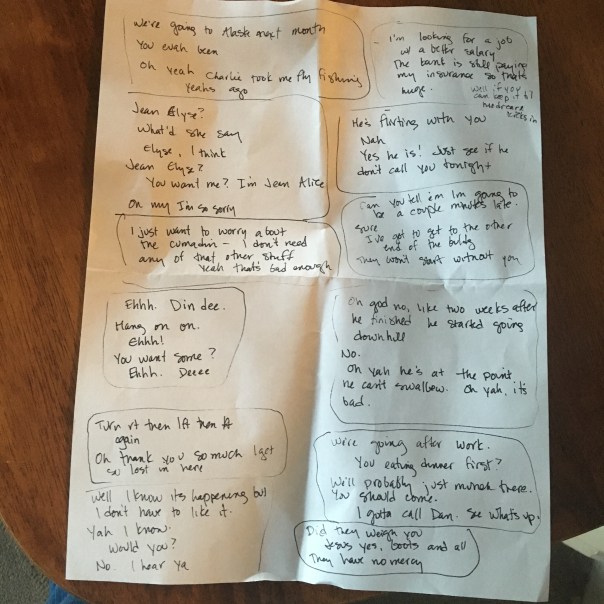
So yesterday as I am sitting in my doctor’s office, which happens to be located at our local hospital. I was struck by a few snippets of conversations I overheard and it dawned on me that every person here has a story. Most of the time we just live our own story and those around us are the supporting characters or ‘extras’. But since I’ve been doing the #SOL16, I’ve been tuning in more to the world around me. So I started jotting down the bits of conversation I was overhearing on the back of my co-pay receipt. Most were very brief soundbites, as the people were walking down the hall past my waiting area.
What stories could I envision from just those short tastes of conversation?
Some were heartbreaking. Some were amusing. Some were rather mundane. Kind of like life! I’m thinking I’d like to keep a collection of “Eavesdropping Inspirations” from a variety of settings. What would it sound like in the lunchroom? The grocery store? The post office? Walmart?!!
I think Shakespeare had something there…
“All the world’s a stage, and all the men and women merely players:
they have their exits and their entrances; and one man in his time plays
many parts.”
What scenes can we script from the players we observe? What stories are waiting to be discovered? What part might we be playing in someone else’s drama?

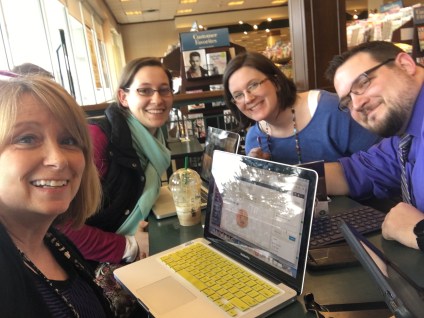
At least once a month I host a Teachers Write group for my school district. The inspiration came from Kate Messner’s Teacher’s Write an online “community of teachers and librarians who believe that people teaching writing should walk the walk.” Over the past two years we’ve had a small but dedicated core of teachers who join me over at our local Barnes and Noble to walk the talk.
We are usually pretty spent at the end of a teaching day and the hit of caffeine from the café is a prerequisite to composing! Each month we have different projects or pieces we are engaged in and it is always interesting to see what captivates each of us enough to put it to paper.
It’s no surprise this month I’m working on my Slice of Life blog post. One of us is working on a fictional thriller. One of us is composing a letter to
persuade administration for more access to technology. One of us is talking! She is stuck for ideas, and as we suggest several she waves them off.
“Hey write about how you listen to Eva* (her young daughter) read her stories to you over and over!”
“Haaa! I can’t I’ll sound like a horrible mother!”
She shares another ’embarrassingly honest’ mommy story with us.
“Write about that!”
“I can’t write that down!”
I share with her the idea of a “Truth Quotient” in writing that I read in Carrie Gelson’s #SOL16 Carrie wrote, “Sometimes we write around what we should not share. We leave hints that likely, only we, ourselves could figure out. Other times, we nudge things a little closer to actually being exposed. But, because we are so very precise in what we do and don’t say, we are still playing it safe.” I suggest my friend could write with the truth quotient turned way down!
The conversations we have each month, eerily mimic the experiences and struggles our own writers have in class. We give ourselves permission to talk them out, seek inspiration, and even decline advice from others. This is all part of the walk of writing. It helps us to remember that our young writers need to take these walks from time to time as well. We certainly aren’t 100% nose to the grindstone during our writing sessions. That’s not how it works!
We try to make our writing time together enjoyable. That is what the best writing workshops strive for as well; creating a community of writers who lift one another up. The more walks I take as a writer, the more I can appreciate and anticipate the needs of our writers.
I know every member of this slicing community is taking a walk each day. Let’s invite more of our friends and colleagues to come along for a walk. We just never know where it might lead.

*not her real name

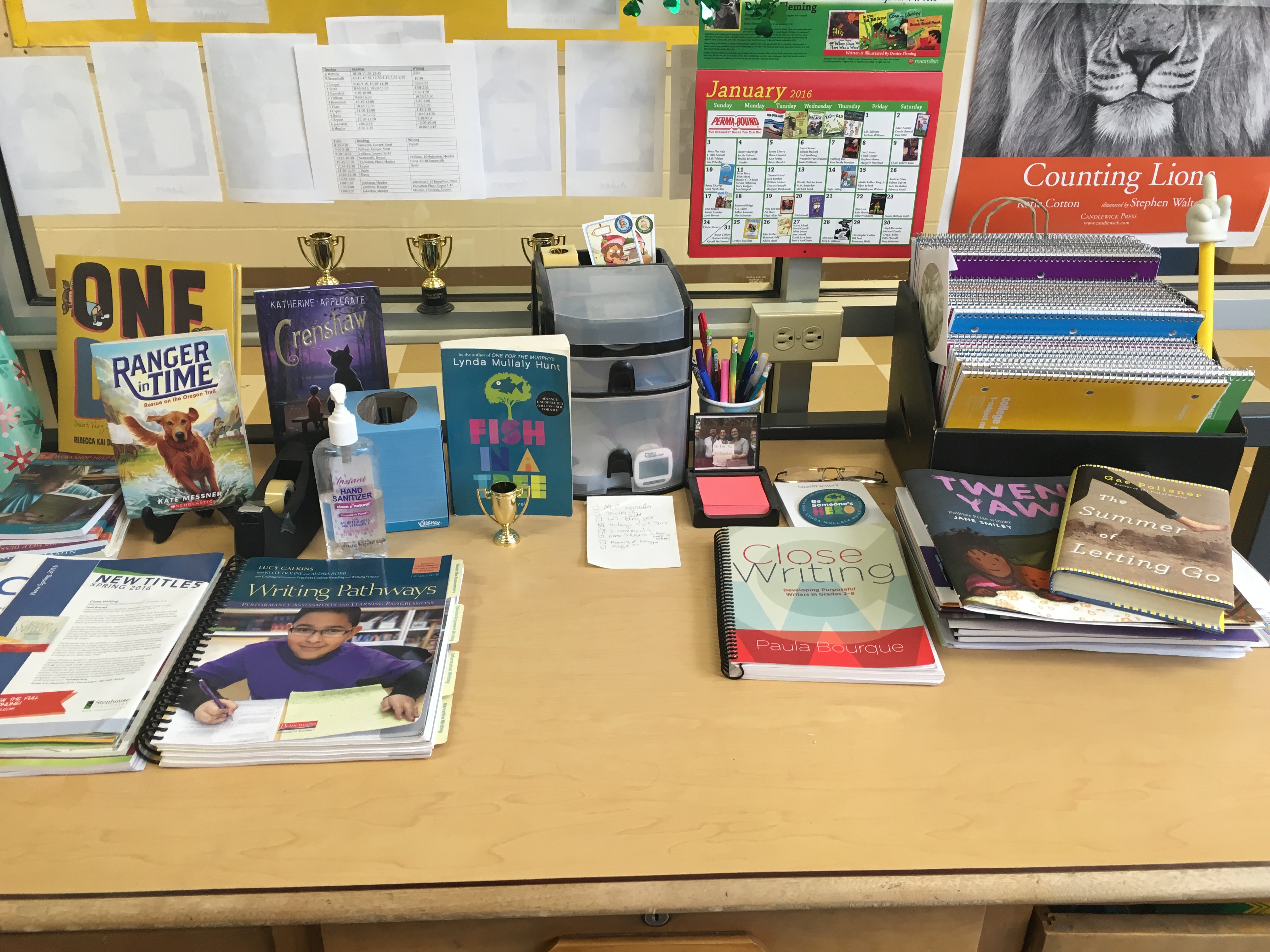
As I’ve already mentioned, I work at 5 schools in 5 days. There are certainly pros and cons to that set up, but one of the consequences that concerns me is the adage “out of sight, out of mind.” In a few of my buildings I don’t have an established space-only a corner of the teachers’ room or a table in a student services room. In those buildings where I do have a space, I share it with other itinerants. So for the 4 days I am not around, the only physical evidence of my existence is the desk and materials I leave behind.
Today I snapped a picture as I packed up and wondered w
hat my impressions would be if this were my co-workers’ desk. What interests her? What is she working on? What does she value? Is she always this cluttered? Does she ever change her calendar? What does this space say about her?
There’s a lot of talk about our carbon footprints, but this year I’ve thought a lot about my coaching footprint. When I’m out of sight, are my teaching ideas out of mind? Does the spirit of my collaboration live on? What do I leave behind at the end of each day that could buttress the teaching and learning in my buildings? What words or deeds did I offer another that might offer lasting sustenance?
Are the traces of my existence meaningful?
It’s hard to know. We plant our seed and let it grow.

I work in five buildings in five days. I often wonder how much of an impact I can make when I feel stretched so thin. Today I got a hint. I was working at the middle school, sitting at my “Dilbert” (cubicle) and working on a presentation for Friday’s workshop. An ed tech approached me and asked, “One of our students, Talia*, wanted to see you. Is this a good time?”
I knew Talia since she was in elementary school. She is one of those kids that you just want to take home with you. Her life was hard. She was quiet to the point of being withdrawn and would never speak up in class. During her 5th grade year I partnered with her teacher to work on a poetry unit. It was there that Talia would quietly pass me her poems. They were dark, and raw, and heartfelt. I knew I couldn’t offer her quick praise, she needed to hear some specifics for it to be meaningful.
“You are really trying to capture a mood here. Your choice of words makes me feel despair at first but there is a sense of hope in this last line.”
She looked down at her paper. “Is it any good?”
I held her paper to my heart. “It’s more than good. It’s so YOU. Your voice is all through this piece. Do you want to give it a title?”
“I don’t know. Maybe.”
“Well, one of my very favorite poets never gave her poems titles. She didn’t feel comfortable sharing her poetry with others either. You remind me a lot of Emily Dickinson.”
Through the rest of the unit, Talia shared each poem with me. I’d point out a technique I thought was strong and try to offer a lift to expand her craft. “I want you to think about your line breaks in this next poem. Poets are intentional with how they want to structure their poems…” The next day she would show me. “I want them to notice this idea so I put this word all by itself…”
The following year Talia shared with me the novel she was writing. Her fan fiction version of a Twilight-type story was gripping, and at times a bit mature. I worried at times about the events in her life that were clearly influencing her writing. The summer she left elementary school I sent her a book of Emily Dickinson poems and a writers notebook. At various times I also sent postcards to encourage her writing. She wasn’t the most skilled writer I’ve worked with, but she was one of the few in which I believed writing could change her life. I wanted to encourage her to continue to work out problems/plots, explore feelings, and find a creative outlet for her hopes and fears.
Now it is a few years later and Talia walks over to my desk. “I wanted you to have this.” She hands me a paper titled Tear the Veil. “I wrote this for my science teacher. We were supposed to research a mammal. She thought it was pretty funny.” I started reading the piece. It was a biography of her favorite band. She had researched the band members and concluded with why they were so important to her life, in helping her to get through some tough times.
“Get it? They’re humans, they’re mammals!”
Oh I got it, and I’m so glad her science teacher did, too. “Talia, you’re a riot! So does your teacher know if you understand mammals?”
“Yeah. And I told her I would research them! I want you to have this copy. I thought you’d like it.”
I did. We talked a bit about how middle school was going. Not great. Not terrible. She talked about her anxiety and an upcoming doctors appointment her mom hopes will help. She talked about friend troubles that she hopes are better now. She told me she is still writing.
I walked her back to her class. “You can share your writing with me anytime, Talia.”
“Okay.” she smiled.
And That, my friends, is a teachers’ fringe benefit.
*(Talia is not her real name)

Sometimes our slices are a little messy. Yesterday’s definitely fit that bill. It was a dance competition weekend for my daughter. On this Sunday she was competing in three different dances spread across the entire day. My husband rarely had the opportunity to see her because he was usually schlepping hockey gear to some frosty ice arena or driving to soccer pitches with our son. (I honestly don’t know how single parents do it!) On this day, however, we made transportation arrangements for our son so my husband and I could both attend one of my daughter’s last dance events in her senior year.
Just before one of her afternoon dances, our son calls. “Murphy (our dog) ate a bag of dark chocolate! I’ve got to get to my soccer game, what should I do?”
Ugh! I had a million questions, “What bag of dark chocolate? How much was in it? Did he eat it all? What’s he doing now? Did any of the other animals eat any?” to which my son worriedly replied “I don’t know, but my ride is here!”
I told him to put the dogs in the crate and as soon as he got home he’d need to let them out. I texted a friend who came right over to check on them. She reported that Murphy was fine and he did ‘his business’ as usual. What a sense of relief!
We watched my daughter take the stage, holding hands, my cheeks slightly damp…my heart beaming with pride. Afterward my husband and I drive to a spot nearby to grab a bite to eat and enjoy some of the lovely weather before returning to the auditorium. Again my son calls.
“There’s puke all over the house! It’s all over the counters, in the tub, and all over the living room! I put the dogs out and tried to clean it up, but Murphy keeps puking and so do the cats! This is too stressful! I covered it up with paper towels and my friend is going to be here in like 30 seconds to pick me up!”
Sense of relief replaced with panic. We can’t leave. My daughter is about to dance again and then we have to wait for the awards ceremony. Where is my clone? I hand the phone to my husband because I can’t believe my son is ready to walk out on that situation. He’ll talk some sense into him.
“Yeah…ok…what time?…Ok…put the dogs in the crate…we’ll be home around 10:00…we’ll pick you up on our way home.”
WHAT? He’s leaving our dogs? Our cats? Our home? Ok, I gave him the phone to handle it, so I have no right to second guess him. We stay and watch our daughter dance her solo and then she frantically works on homework until the awards ceremony.
Flash forward to 10:15. We walk in the door and there are the piles of paper towels my son told us about. We lift them up and there are black stains the size of basketballs in three different places in the living room. There is my Murphy covered in black puke in his crate. But wait, there are bonus splatters of black vomitus in other carpeted rooms of the house. The good news is it wasn’t dark chocolate. The bad news is it was black candy making melts.
We assess the disaster area. “Quick, Google ‘how to get food dye out of carpet’!”
I’m guessing 6 hours later is not “as soon as you notice it”. Covering the mess with paper towels is not the same as blotting. Seriously…NO vinegar in the whole house on a Sunday night after the stores have closed!? Quick…more Google searches.
Soak for 15 minutes in mixture of 1 quart lukewarm water, one-half teaspoon liquid hand dishwashing detergent and one tablespoon ammonia.
Does Windex count as ammonia? It does tonight. By midnight we are exhausted. The black diminished to varying shades of grey. We trudge to bed, not at all hopeful that we’ll awake to a miracle ablution. But our pets are ok. My husband is my rock! My daughter is a beautiful dancer. My son…he’s toast!


Once there was a man.
He wanted to make his country great again.
He built walls to create borders.
He made them pay for it.
He wanted to rid us of others.
He rounded them up and marched them
off the earth.
He “told it like it was”
over and over and over.
He vilified the press and any who questioned him.
He tapped into the rage of a people.
He ignited the fires of hostility.
He whipped the crowds into a frenzy,
crowds of people desperate for a strong leader.
He was very popular.
Until he wasn’t.
I’ve revised this poem many times as each act of hatred, each call to aggression, each digression of humanity seemed to dip beneath what I thought was a new low. I do not wish to become despondent and depressed. I want to TRUMP hatred with love, prejudice with acceptance, anger with understanding, and lies with truth. I want us to examine, “What ARE our values?” I want us to LIVE them, not just in our politics, but in our daily lives.
Now is the time for good men (and women) to do something.
Peace out.

Yesterday sign ups opened for a workshop day next week. I love that our district is adopting an EdCamp-ish model of offering voice and choice in our professional development opportunities. I’ll be presenting at one of the sessions, and so I had two others in which to choose my own PD. As I looked down the list of offerings I was struck by how many were not related to academics at all.
Schools have clearly had to become more than institutions of learning. We’ve had to
become caregivers. That is not to say we hadn’t always been to some degree. Most of us are here to teach the child and not just the curriculum, and so we have always looked for ways to support the needs of our learners; whether they were academic, emotional, social, or physical.
Our schools offer food, clothing, counseling, behavioral support, health care clinics, dental cleanings and screenings, vaccinations, homeless liaisons… Teachers are expected to become highly qualified in our area of instruction and ensure that ALL students become highly proficient in achieving the standards. In essence, we are expected to become everything for everyone. And we try! I don’t know how many conversations I have each week with teachers stressing over their struggle to meet the needs of a child (or children) in their classrooms because their needs are greater than we can address.
And so I applaud our school district for recognizing that teachers need support to help these students, and that these students may have nowhere else to turn for that help. I am proud that our teachers are putting the most basic of our students’ needs first and learning about ways to address them. But I am sad that we don’t have more sessions for sharing amazing book titles, implementing genius hour, sharing successful strategies and practices, etc. I am sad that our students need us to focus our energy and professional development on dealing with societal issues that are causing them such trauma and grief. And I am incredibly sad for so many of our students.
I will balance my day by offering a session on Close Writing to help foster greater purpose and passion for our students in writing, and then taking sessions to help me better understand the non-academic needs of my students. I will focus my professional development on supporting the whole learners…the human beings who are counting on me to make a difference in their lives.
Oh, and our high stakes standardized testing starts the next Monday.
‘Nuff said.
Yesterday a post came across my Facebook wall and Twitter feed that filled me with hope. It
reinforced for me the power of the pen- (or the crayon!) It inspired me to work even harder to help our youngest writers find their voice.
It was a piece of writing from a third grader in North Carolina. As part of a class project he penned a letter to Donald Trump saying quite eloquently what so many of us would like to. He laid out his position with regards to the behavior he finds offensive and frightening. He argued for an implementation of the Golden Rule. He appealed to Mr. Trump to “start thinking about the children in this country” and he shared the thoughts, hopes, and fears of many children. He has a voice and found a way for it to be heard. He is a writer!
(And I noticed the tone of last night’s debate considerable more civil…coincidence?)
This reminds me of another famous young writer who’s words had an impact in the world. In 1982 Samantha Smith, a 10 year old girl from my state of Maine, wrote a letter to Yuri Andropov, a newly elected leader in the Soviet Union. In it she said:
Dear Mr. Andropov,
My name is Samantha Smith. I am ten years old. Congratulations on your new job. I have been worrying about Russia and the United States getting into a nuclear war. Are you going to vote to have a war or not? If you aren’t please tell me how you are going to help to not have a war. This question you do not have to answer, but I would like to know why you want to conquer the world or at least our country. God made the world for us to live together in peace and not to fight.
Sincerely, Samantha Smith
Andropov not only responded to her letter, but invited her to Russia. She became one of America’s youngest goodwill ambassadors and influenced the conversation moving forward in Russian relations.
Sure these letters have garnered national attention, but we cannot underestimate the capacity for our students’ writing to influence others. When we help them find their voice and share their ideas through their writing we are empowering them in ways we may not yet fathom or ever know.
Out of the mouths of babes (…and onto the paper)!
Darkness.
My muse kisses my brow.
I roll over and reach for my pen,
holding the thinking in my head until I secure my notebook.
Becoming proficient with blind scrawling.
Ideas flow from my sleepy brain to the beckoning page.
There it awaits a more lucid reader at dawn.
I retreat into my downy burrow
Hopes of REM diminishing
This dormancy far too brief
when inspiration calls again.
Several years ago, as I began cultivating my ideas for CLOSE WRITING, I found my sleep pattern forever transformed. Almost every night, I dream lessons and conversations with learners and awake in the predawn hours with ideas bursting from my head. I have notebooks and scrap papers littering my bedside -inspiration overload. If I can release them to paper, I am often able to catch a few more zzzz’s, but more often than not, I’ve only opened the floodgates!
Enter my caffeine infused world of laughter and sarcasm.
"How vain it is to sit down to write when you have not stood up to live! Methinks that the moment my legs begin to move my thoughts begin to flow..." -- Henry David Thoreau, August 19, 1851
finding energy through art and writing
Thinking and writing about teaching, parenting and life.
Where writing teachers walk the talk, capture small moments, and courageously share their words.
Pushing my limits...writing, reading, photography, running, life...
Sharing my life as a K teacher and mom of 2!
1st grade
Authentic Learning, Authentic Assessment, Authentic Faith
Lit On Fire!
In everything that my students and I do together, we strive to find ways to use reading and writing to make the world outside of our classroom a better place for all of us to be
Smarter Charts from Marjorie Martinelli & Kristine Mraz
...one literacy teacher's professional journey
A community of readers